About Zieria compacta C.T.White
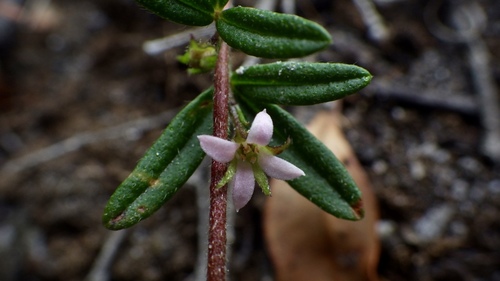
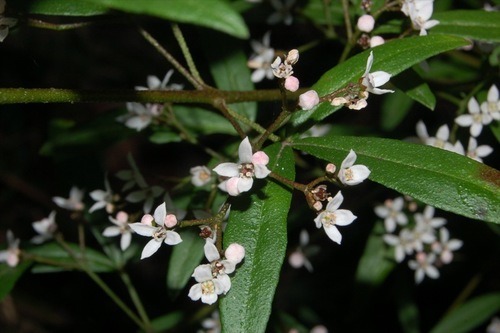
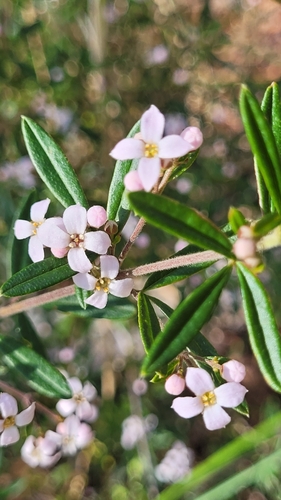
Zieria compacta C.T.White is an erect, bushy shrub that grows to around 2 meters (7 feet) tall. Its branches are smooth, do not have obvious glands, and are covered in a dense layer of hairs, particularly when the branches are young. This species has compound leaves made up of three leaflets, which range in shape from elliptic to egg-shaped. The middle leaflet measures 6–35 mm (0.2–1 in) long and 1.5–8 mm (0.06–0.3 in) wide, and the other two leaflets are smaller. The leaf stalk is 2–8 mm (0.079–0.31 in) long. The upper surface of the leaves is hairless and dark green, while the lower surface is paler green, covered in a thin dense layer of hairs, and has a clearly visible mid-vein.
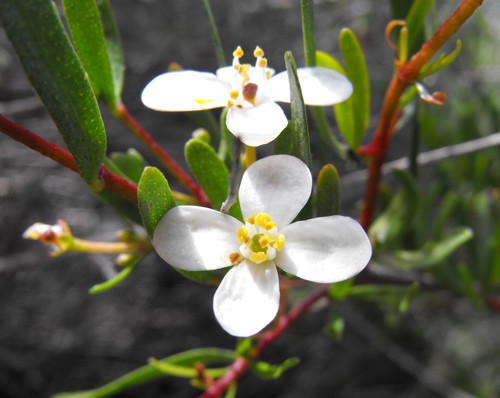
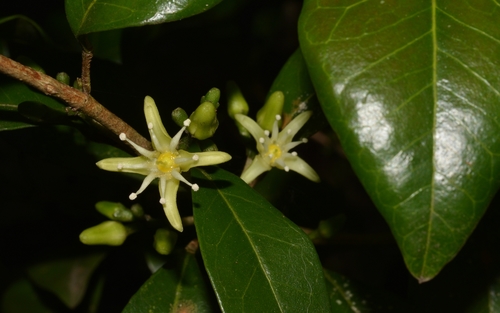
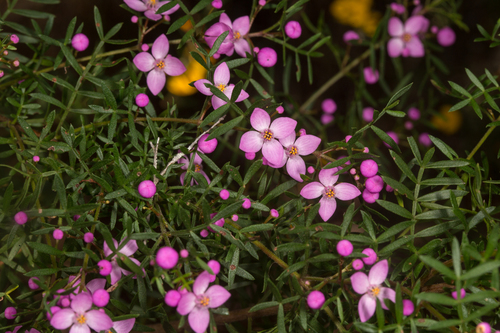
The flowers are white to pale pink, and are arranged in leaf axil groups that most often contain around six flowers, though groups may have as few as one or as many as 35. The flower groups are usually roughly the same length as the leaves. The plant has four sepal lobes, each 1.5–2.5 mm (0.06–0.1 in) long and hairy on the outer surface. There are four petals, each 2–2.5 mm (0.08–0.1 in) long, and like other zierias, this species only has four stamens. Flowering takes place in spring, and after flowering the plant produces fruit: a hairless follicle made up of up to four sections joined at the base, which splits open to release its seeds when ripe.
This zieria occurs mainly from south of the Darling Downs and Fraser Island in Queensland to the far south coast of New South Wales. It most commonly grows on steep rocky hillsides in poor soils near granite or sandstone.