About Zesius chrysomallus Hübner, 1823
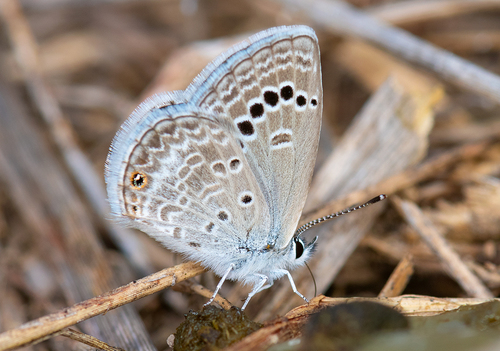
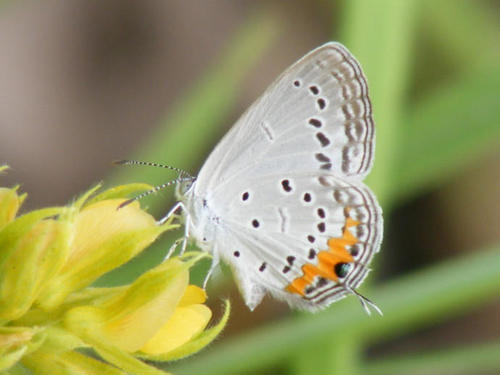
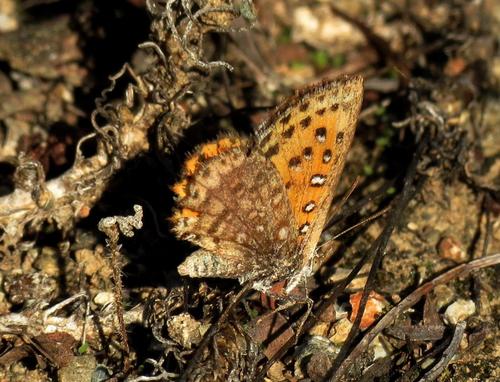
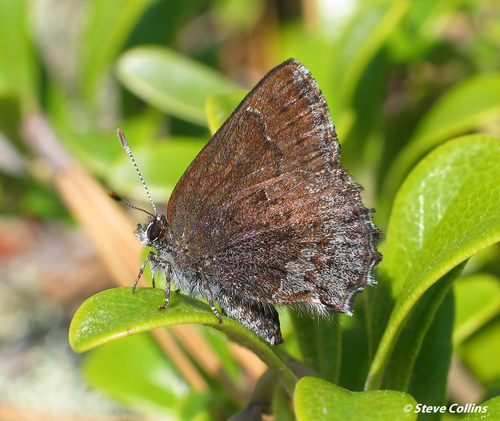
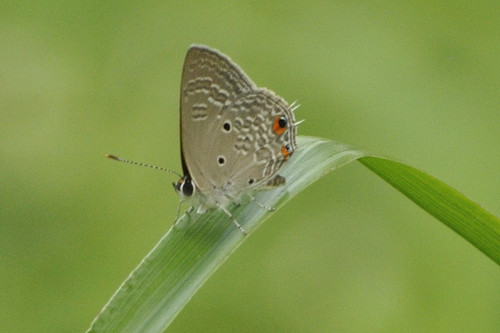
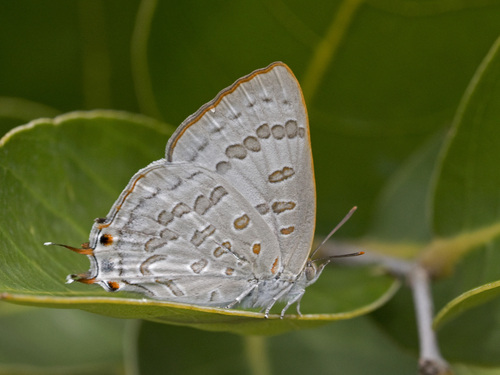
This is a description of Zesius chrysomallus Hübner, 1823, covering both male and female morphology, plus the known host plants for its larvae. For males: The upperside is pale cupreous-red, with finely blackish-brown veins. The forewing has a narrow brown band of fairly even width along the entire costa and outer margin. The hindwing has pale brown costal space and abdominal fold; its outer margin is more narrowly brown, narrowing toward the hind end. The abdominal area outside the fold has a narrow brown suffusion. There is one sub-terminal brown spot in each of the three anal interspaces, margined by a slender greyish-blue line that is often obsolescent; the tails are brown and tipped with white. The underside is pale grey, with pale reddish-brown markings edged by dark brown and white lines. The forewing has three somewhat linear spots in the cell, increasing in size from the base outward: sub-basal, medial, and terminal. A similar spot sits below the medial spot. There is a discal band of six conjoined spots, plus a seventh disconnected spot. The series is slightly curved outward and somewhat irregular: the fourth and sixth spots from the costa sit a little further outward, and there is some dark suffusion in the middle of the hinder marginal space. The hindwing has a small round sub-basal spot in the cell, one spot on the costa above the cell, and another below it. It has a larger spot in the middle, with a still larger spot on the costa above this middle spot, and a smaller one below it. At the end of the cell, there is a bar made of two conjoined spots, with the lower spot shifted half outward. There is an outwardly curved discal series of nine spots: the first six from the costa are conjoined, the second is the largest, and its outer lower end touches the inner upper end of the third. The fifth spot sits inward, the sixth and seventh are outwardly oblique, the latter is somewhat linear and detached. The ninth spot is represented by a short line that runs inward on the abdominal margin and is well separated from the seventh; the eighth spot is a minute spot between the seventh and ninth. There is a small black spot at the anal angle and another in the first interspace, both capped with orange. Some blue and white scaling is present in the interspace between these two black spots, and there is a white anteciliary thread running from the anal angle to vein 2. Cilia are brown, with a white line running through their middle. Both wings have a sub-marginal series of small lunular marks, which are only faintly visible on the forewing. Antennae are black and whitish beneath, the club has an orange-red tip; the frons is black; the head and body are blackish-brown above and grey beneath. For females: On the upperside, the forewing is pale blue, with blackish-brown outer borders that carry a violet tint. The border is narrow on the costa from the wing edge to the end of the cell, and also narrow on the hinder margin. The apex is broadly blackish-brown, and the band running down the outer margin is about twice as wide as the band along the costa. The width of all these blackish marginal bands varies somewhat between individual specimens. The hindwing has blue ground colour that is more or less suffused with blackish-brown across its entire area, with the darkest suffusion on the costal part. There is a very small anal black spot, which is sometimes absent. There is a large sub-terminal black spot in each of the next two interspaces after the anal spot, plus some smaller sub-terminal spots that become obsolete moving upward. The spot in the first interspace is crowned with orange, while the other is crowned with whitish. A white line runs inside the black terminal line. Tails are blackish and tipped with white; the extra tail at the end of vein 3 is about half the length of the other tails. The underside matches the male’s, except the ground colour is paler. The host plants for Zesius chrysomallus larvae are Terminalia catappa and Smilax zeylanica.