About Zephyranthes robusta (Herb.) Baker
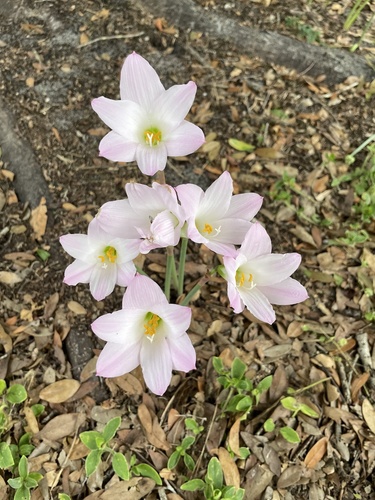
Zephyranthes robusta (Herb.) Baker is a relatively large species of rain lily. It grows from ovate to obovate bulbs that are around 3.5 to 5 cm (1.4 to 2.0 in) in diameter. Each plant produces a single solitary flower, which ranges in color from lavender to pale pink and is funnel-shaped. The flower is 5–6 cm (2.0–2.4 in) long, held at a slight angle on a 15–30 cm (5.9–11.8 in) scape, and has a leaf-like bract 1.8–4 cm (0.71–1.57 in) long at the base of the scape. Flowers typically emerge after rain from late summer to early fall. After flowering, large deep green leaves develop; the leaves measure 5 to 10 mm (0.20 to 0.39 in) wide and 30 to 40 cm (12 to 16 in) long. Zephyranthes robusta is believed to have originated from Rio Grande do Sul, Brazil. It is native to Brazil, Argentina, and Uruguay, and is widely naturalized in other areas. Like closely related Zephyranthes species, Z. robusta contains toxic alkaloids, mainly galantamine-type alkaloids that can be lethal for humans. Zephyranthes robusta is widely grown as an ornamental plant. It is one of the most prolific summer-flowering rain lilies. It can be propagated by dividing bulbs, including bulb offsets, and by growing from seed. It is less tolerant of colder temperatures than other rain lilies.