About Zenithoptera fasciata (Linnaeus, 1758)
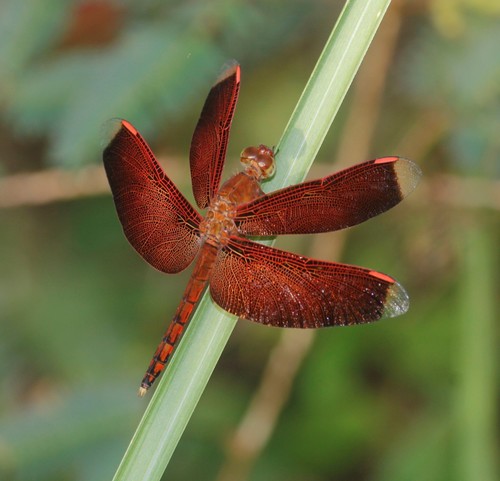
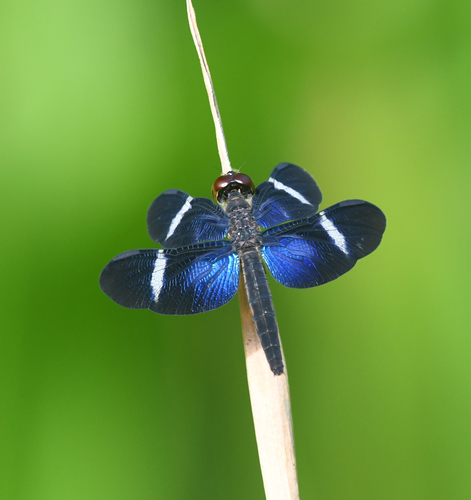
Zenithoptera fasciata, also known by its common name, is easily recognized by its bright, iridescent blue wings. The wings are mostly uniformly colored, but sometimes show a lighter band just before the apex; this lighter band is far more consistently present in the closely related species Zenithoptera lanei. The side surface of the thorax is dark brown with narrow, irregular yellowish bands. Males have two broad, light markings on the underside of their thorax, and a lighter band often runs from the thorax's front edge to its back edge. The abdomen is dark brown, and usually has narrow yellow bands along the back edges of each abdominal segment. The larva of this species has not yet been formally described. The total range of Zenithoptera fasciata is estimated to cover more than 1,638,000 square kilometers. Individuals have been observed from Costa Rica, southward through Brazil and Peru, and the species occupies a large portion of the Amazonian Basin. It is confirmed as a native species of Bolivia, Brazil, Colombia, Costa Rica, French Guiana, Guyana, Peru, Suriname, Trinidad and Tobago, and Venezuela. This species lives in tropical and subtropical forests, rainforests, and wetlands. Adult Zenithoptera fasciata spend most of their time in the forest canopy, only descending to lower areas for short periods. These descents typically happen in midday sun, and are often just long enough for brief breeding interactions. When below the canopy, the dragonflies commonly rest at shallow pools overgrown with low grasses and sedges, or in less dense areas of forest. In these open spots, they perch on elevated ground or on tall, thin twigs. When perched, their wings are usually held straight up above the body; they are occasionally lowered suddenly into a deflected position.