About Zelkova serrata (Thunb.) Makino
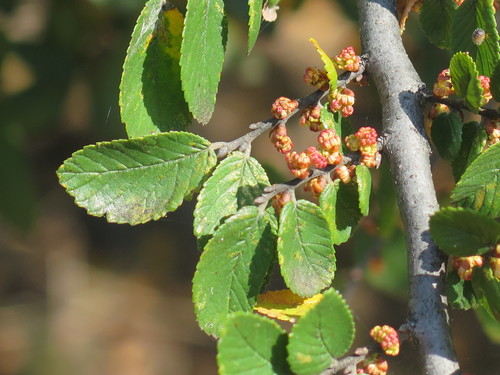
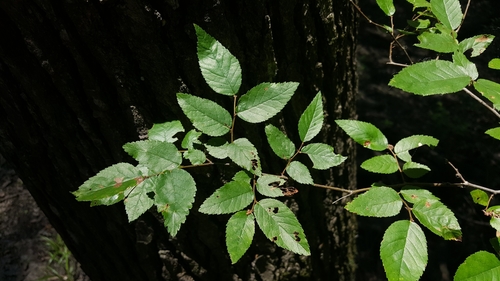
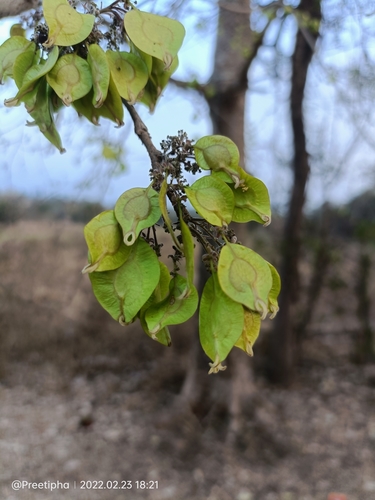
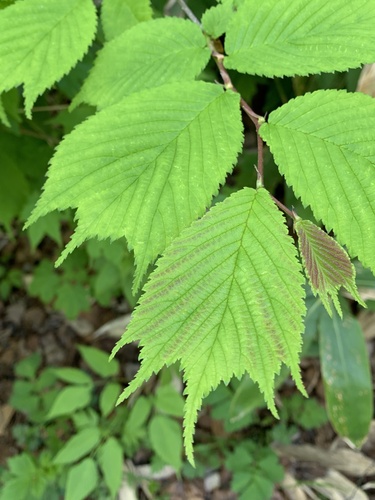
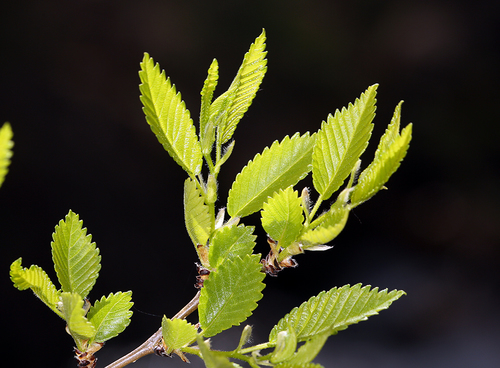
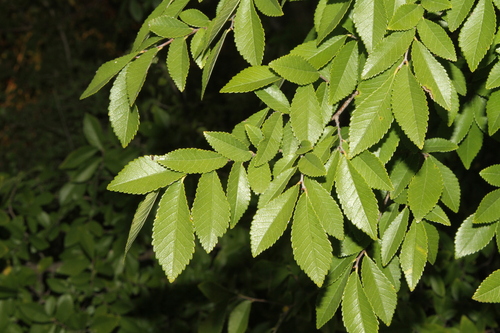
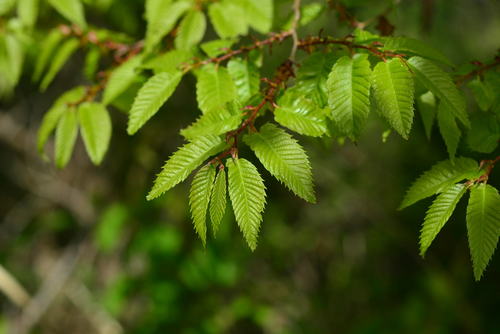
Zelkova serrata (Thunb.) Makino is a medium-sized deciduous tree that typically reaches 30 m (98 ft) in height. It is defined by a short trunk that splits into many upright, erect spreading stems, which form a broad, round-topped head. Young trees grow rapidly, while their growth slows to a medium rate once they reach middle age and maturity. Its leaves are alternately arranged, growing up to 5 cm (2 in) long and wide. The leaves are simple, shaped ovate to oblong-ovate with serrated or crenate margins—this feature gives the tree its specific epithet serrata. Leaf tips are acuminate or apiculate, leaf bases are rounded or subcordate, and leaves hold 8–14 pairs of veins. The upper surface of the leaves is rough, while the underside is glabrous or nearly glabrous. Leaves are green to dark green through spring and summer, and turn yellow, orange, and red in autumn. Leaf petioles measure 2–5 mm (1⁄16–3⁄16 in) long. Zelkova serrata is monoecious. Flowers develop in spring alongside new leaves. Tree buds are ovoid, slightly pointed, and covered in many overlapping dark brown scales. Buds grow out from stems at a 45-degree angle. Staminate flowers have short pedicels, are around 3 mm in diameter, and grow clustered in the axils of lower leaves. Pistillate flowers are either solitary or few in number, grow in the axils of upper leaves, are sessile, and typically measure around 1.5 mm in diameter. All flowers are yellow-green, not showy, and grow in tight groups along new stems. After flowering, the tree produces small, ovate, wingless drupes that ripen from late summer to autumn. Drupes are green when young, turning brown as they mature, are subsessile, and measure 2.5 to 3.5 mm (3⁄32 to 1⁄8 in) in diameter. To identify Zelkova serrata, look for a short main trunk, low branching, and a vase-shaped growth habit. Twigs are slender, with small dark conical buds arranged in a zigzag pattern. Branches are usually glabrous. Bark ranges from grayish white to grayish brown, and is either smooth with lenticels or exfoliates in patches to reveal orange inner bark. Branchlets are brownish-purple to brown. Zelkova serrata is planted as a lawn or park tree, valued for its attractive bark, fall leaf color, and vase shape. It provides good shade and makes fall cleanup easy. It is simple to transport, and is often sold wrapped in burlap. It is also commonly used for bonsai, as its attractive shape and colors make it a popular choice for the practice. It is often grown as an ornamental tree, both in its native range and in Europe and North America. The first cultivation of the species outside Asia was done by Philipp Franz von Siebold, who introduced it to the Netherlands in 1830. In recent times, it has been planted as a street tree in New York City and Philadelphia. In the United Kingdom, it has received the Royal Horticultural Society's Award of Garden Merit. Within the United Kingdom, the Royal Horticultural Society's Plantfinder currently lists 38 suppliers for the pure species and its associated varieties. This tree needs full to partial sun, and prefers moist, well-drained soils. A fertilizer high in potassium and nitrogen encourages new growth and floral buds. It is adaptable, and tolerant of heat, limited water, nutrient-poor soils, and a wide range of pH levels. It should be periodically thinned to let light reach the inner canopy. Zelkova serrata can be propagated by seeds, rooted stem cuttings, and grafting. Seeds can germinate without pretreatment, though germination rates are higher when seeds are stratified at 5 °C (41 °F) for 60 days. Because germination requires stratification, seeds are best sown early in the year. To help seedlings survive their first winter, it may be necessary to pot them and grow them in a greenhouse during this time. They can be moved to their permanent location after the final frost of spring. Numerous cultivars have been selected for cultivation. It has also hybridized with Zelkova carpinifolia in Europe; the resulting hybrid is named Zelkova × verschaffeltii. In Japan, the wood of keyaki (Zelkova serrata) is highly valued. It is often used to make furniture such as tansu, and is considered the ideal wood for constructing taiko drums.