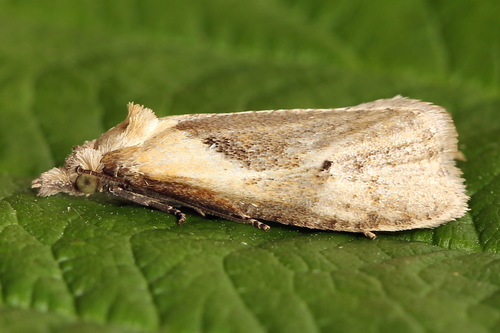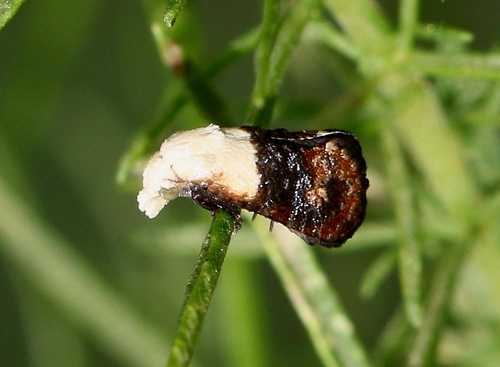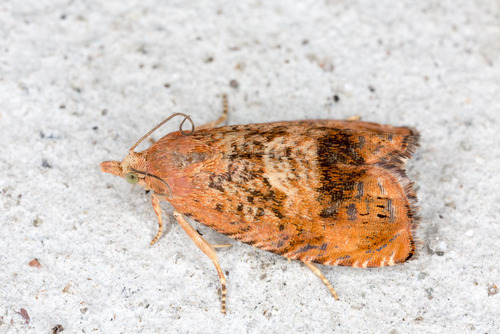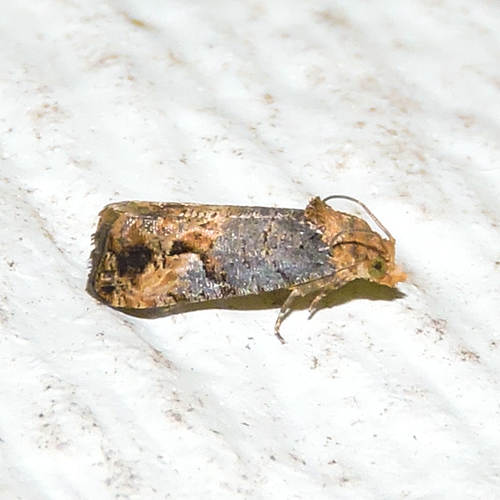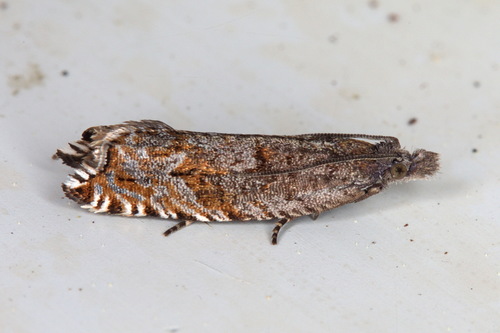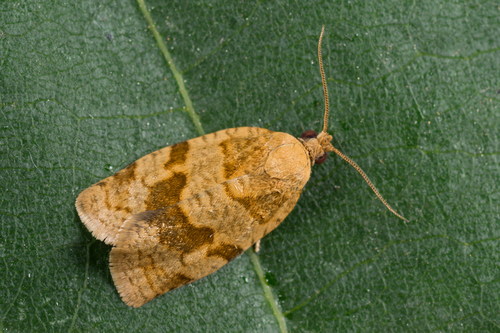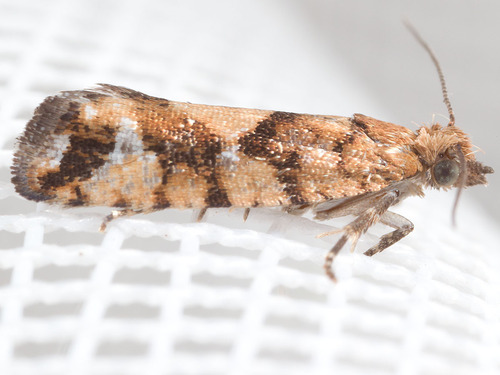
About Zeiraphera canadensis Mutuura & Freeman, 1967
Zeiraphera canadensis, commonly known as the spruce bud moth, is a species of moth in the family Tortricidae. This small brown moth is mainly found in North America, specifically in the Canadian provinces of New Brunswick and Quebec, as well as in the northeastern United States. During the day, adult spruce bud moths fly quickly close to the ground among trees; after sunset, they fly higher above tree cover. The spruce bud moth relies primarily on the white spruce tree as its host plant. Both males and females of this species mate multiple times, but males can secrete accessory gland proteins that prevent females from re-mating. The species is univoltine, meaning only one generation hatches each year, and its eggs overwinter from July to May. Zeiraphera canadensis is very similar to the related species Z. ratzeburgiana, and the two can only be distinguished by the presence of an anal comb in Z. canadensis. In 1980, the spruce bud moth was classified as a pest because of its negative impacts on the growth of white spruce trees. It defoliates young white spruce trees, stunts their growth, and deforms their buds. While the moth does not kill spruce trees, the deformation it causes reduces the quality of wood harvested from spruce plantations. Because of this, a great deal of research is focused on developing control methods for the spruce bud moth, including using sex pheromones in traps and annual pesticide sprays. The spruce bud moth is mostly found in Canada, concentrated in New Brunswick and Quebec. It also occurs across other parts of North America, particularly in the northeastern United States, with large high populations specifically recorded in Maine. It generally lives in colder regions, because its ovipositing and mating behaviors are strongly temperature dependent. The spruce bud moth gets its common name from its host plant, which is also its main habitat, the white spruce. While it has a transcontinental range across North America, it is most frequently found on white spruce, and only occurs occasionally on other species of spruce and fir. Spruce bud moth larvae hatch inside the buds of white spruce trees. Most of the moth's development, as well as its adult life, ovipositing, and mating, takes place on this tree, making white spruce a key part of the moth's life cycle and habitat. As a result, the moth's distribution is limited to regions with high densities of white spruce trees, such as Canada and other northern temperate regions.