About Zanthoxylum piperitum (L.) DC.
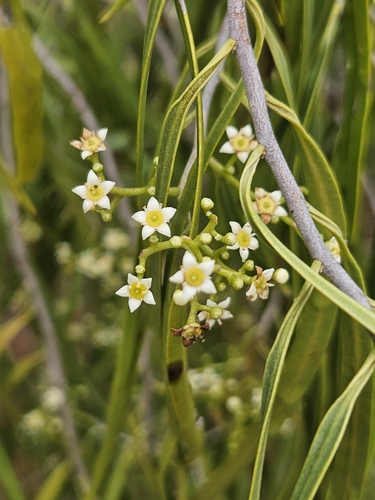
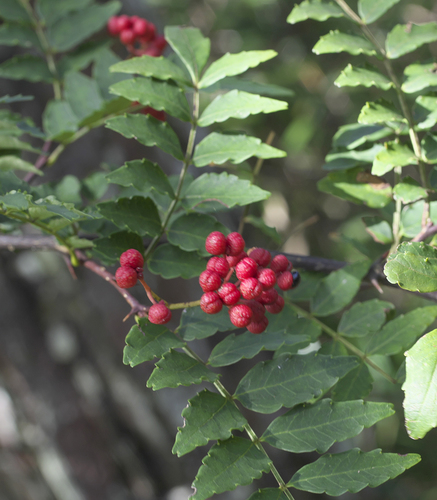
Zanthoxylum piperitum (L.) DC. is a member of the citrus and rue family, Rutaceae. This tree blooms from April to May, forming axillary yellow-green flower clusters around 5mm in size. The species is dioecious: male flowers of the plant are edible as hana-sanshō, while female flowers produce 5mm berries (or peppercorns). In autumn, the berries ripen to a scarlet color, split open, and scatter the black seeds inside. Branches grow paired sharp thorns, and the plant produces alternately arranged odd-pinnately compound leaves, which hold between 5 and 9 pairs of ovate leaflets with crenate (slightly serrated) margins. This species is a host plant for Papilio xuthus, the citrus swallowtail butterfly that is native to Japan and has since spread to Hawaii. Chemical analysis has found that its seeds hold very high concentrations of sugar-modified glucoside derivatives of N-methylserotonin and N,N-dimethylserotonin, which is also known as bufotenin. The natural range of Zanthoxylum piperitum extends from Hokkaido to Kyushu in Japan, the southern portion of the Korean peninsula, and the Chinese mainland. In cultivation, 80% of Japan’s domestic production of this species is grown in Wakayama Prefecture. Aridagawa, Wakayama is known for a specialty variety called budō sanshō (grape sanshō), which produces large fruits in clusters shaped like a bunch of grapes. The thornless variety, Asakura sanshō, is named for its place of origin: the Asakura district of the now-disbanded Yokacho, which has been merged into Yabu, Hyōgo. In Japanese folk medicine and pharmaceuticals, mature seed-removed husks of this plant are the crude drug form of sanshō. It is an ingredient in bitter tincture, and in the ceremonial toso wine. Its characteristic pungent taste comes from the compounds sanshool and sanshoamide. It also contains aromatic oils including geraniol, dipentene, and citral, among others.