About Zanthoxylum nitidum (Roxb.) DC.
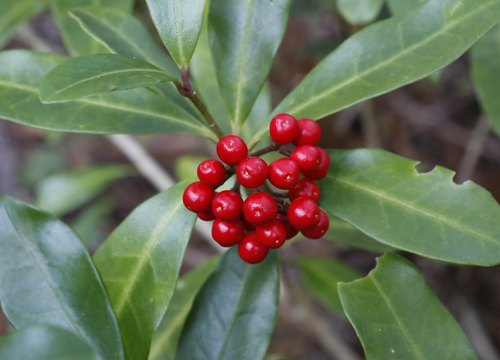
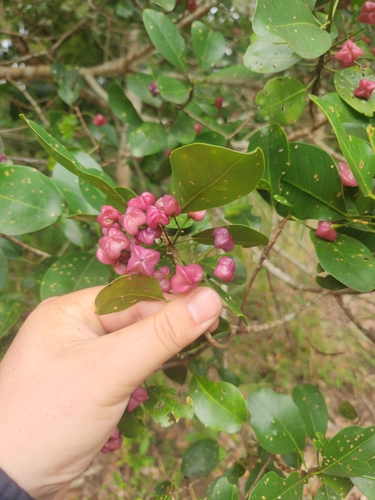
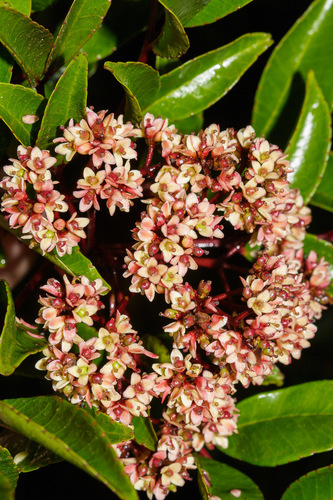
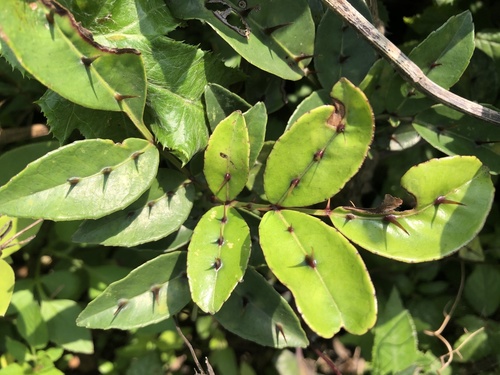
Zanthoxylum nitidum (Roxb.) DC. is a woody climbing plant. It has curved prickles on its branchlets, and thick, cone-shaped spines on its trunk and older branches. Its leaves are pinnate, and measure 100–340 mm (3.9–13.4 in) long. Each leaf holds five to nine egg-shaped to elliptical leaflets. Individual leaflets are 45–100 mm (1.8–3.9 in) long and 20–50 mm (0.79–1.97 in) wide. Side leaflets are either sessile, or attached on a petiolule up to 3 mm (0.12 in) long, while the end leaflet grows on a petiolule 7–40 mm (0.28–1.57 in) long. Flowers are arranged in panicles or racemes up to 80 mm (3.1 in) long, growing from leaf axils or the ends of branchlets. Each individual flower sits on a pedicel 1–1.5 mm (0.039–0.059 in) long. Flowers have four sepals 0.5–0.8 mm (0.020–0.031 in) long, and four white or pale yellow petals 2–3 mm (0.079–0.118 in) long. Flowers are either functionally male or functionally female. Male flowers have four stamens around 3.5 mm (0.14 in) long, plus four sterile, finger-like carpels. Female flowers have no stamens, and hold four carpels 1.5–2 mm (0.059–0.079 in) long. Flowering takes place from September to October. The fruit is a roughly spherical, red or brown follicle 5–7 mm (0.20–0.28 in) long. This species is distributed across India, South China, southeast Asia, and northern Australia. In Australia, it grows in rainforest from sea level up to an altitude of 400 m (1,300 ft), ranging from the Daintree River south to Rockingham Bay. Zanthoxylum nitidum is used as an insecticide and a piscicide. In India and Nepal, its fruits are used as a condiment. The roots, leaves, and fruit of this plant are poisonous; as little as 40g of its leaves is considered a lethal dose.