About Zanthoxylum brachyacanthum F.Muell.
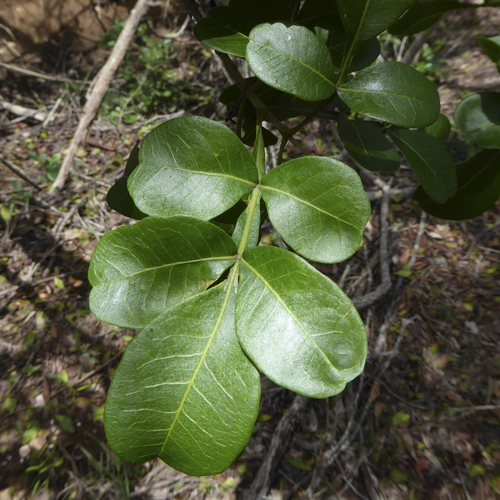
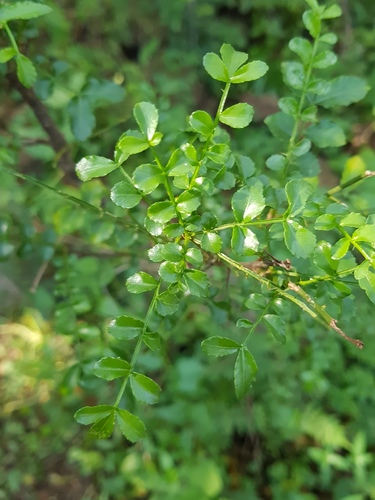
Zanthoxylum brachyacanthum is a shrub or tree that typically grows to a height of 25 m (82 ft). It usually has prickles on its branches, and thick, cone-shaped spines on its trunk and older branches. Its leaves are pinnate, arranged alternately, seven to thirteen leaflets per leaf, and 120–300 mm (4.7–11.8 in) long. Leaflets are egg-shaped to elliptic, 40–150 mm (1.6–5.9 in) long and 15–55 mm (0.59–2.17 in) wide. Side leaflets are borne on a 30–90 mm (1.2–3.5 in) long petiolule, while the end leaflet is on a 30–180 mm (1.2–7.1 in) long petiolule.
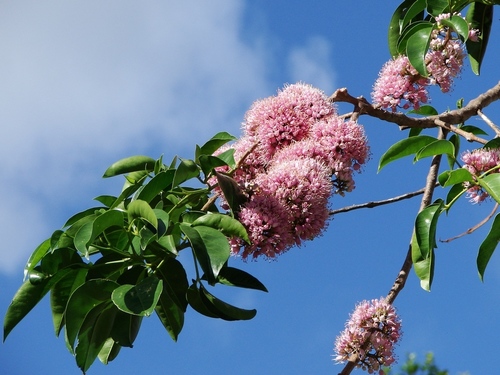
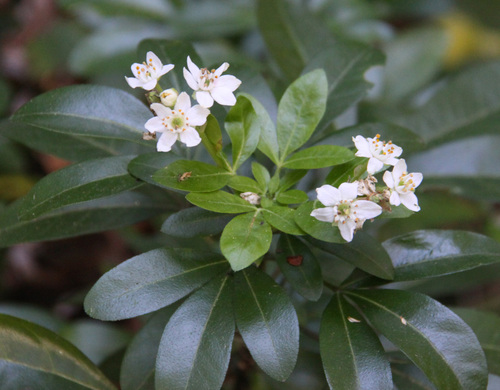
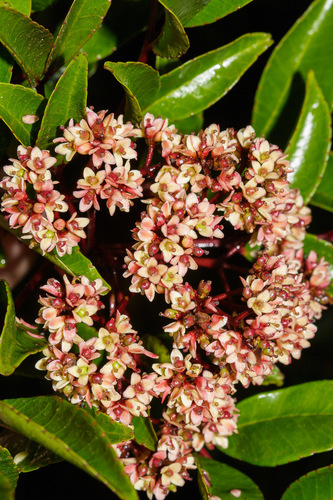
Flowers are arranged in 15–25 mm (0.59–0.98 in) long panicles that grow at the ends of branches, in leaf axils, or both positions. Flowers are either sessile or borne on pedicels up to 2.5 mm (0.098 in) long. They have four sepals joined at the base, each about 1 mm (0.039 in) long, and four greenish cream-coloured petals 4–5 mm (0.16–0.20 in) long. Male flowers have four stamens 3.5–8 mm (0.14–0.31 in) long, with anthers about 3 mm (0.12 in) long. Female flowers have a single carpel about 3 mm (0.12 in) long with a short style, and sometimes have rudimentary stamens. Flowering occurs from September to November.
The fruit is a shiny bright red, later wrinkling to dark brown, spherical or oval follicle 7–8 mm (0.28–0.31 in) long, which contains a single black seed.
This species grows in a variety of subtropical, tropical, and drier rainforest types, often on volcanic soils. Young individuals are easily identified in rainforest by their thorny trunks. Its natural range extends from the Clarence River (29° S) in New South Wales north to tropical Queensland, occurring in Eungella National Park and the Wet Tropics region.
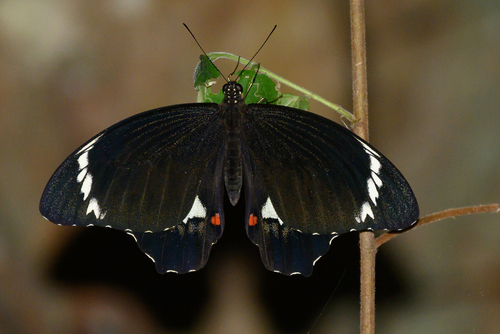
The leaves of Zanthoxylum brachyacanthum are a food source for the larvae of several butterfly species: the orchard swallowtail butterfly, the fuscus swallowtail, and Papilio polyctor.
This plant, commonly called thorny yellowwood, is considered a good candidate for use as an ornamental plant due to its generally small size, distinctive trunk, and attractive flowers and foliage. Its timber is deep yellow and close-grained, making it potentially suitable for decorative work. Plants in the family that Zanthoxylum brachyacanthum belongs to contain a range of compounds including alkaloids, coumarins, furanocoumarins, pyranocoumarins, acetophenones such as zantholoxylin, flavanoids like amurensin, polyhydroxol flavanoids, and amides. The leaf essential oil of Z. brachyacanthum is rich in α-pinene (46%), β-caryophyllene (14%), and bicyclogermacrene (12.5%).