About Zanthoxylum avicennae (Lam.) DC.
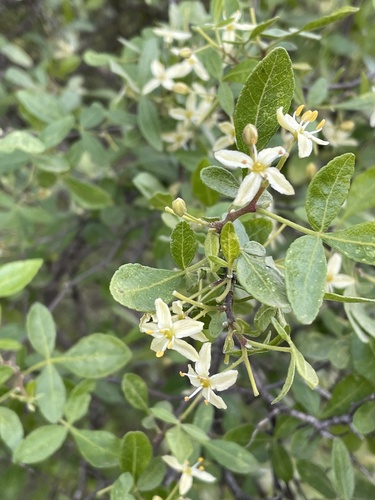
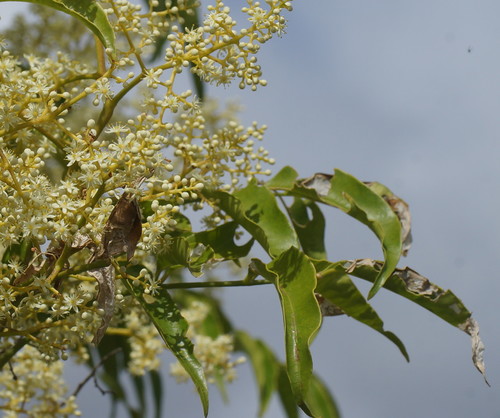
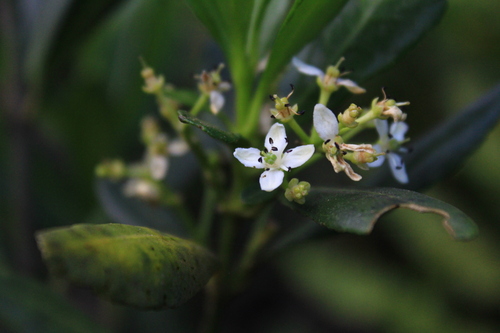
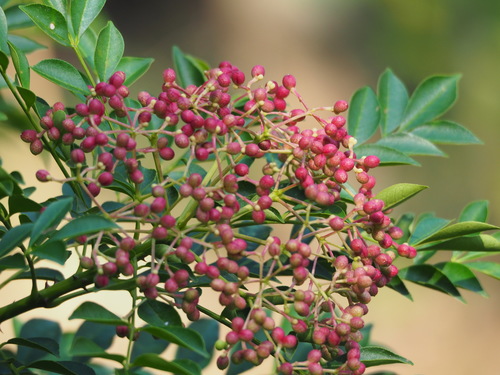
Zanthoxylum avicennae (Lam.) DC. is a deciduous tree that grows up to 15 meters tall. Its trunk bears chicken-foot-like thorns; the base of each thorn is oblate, thickened, bulge-shaped and marked with ring patterns. Leaflets on the branches of young seedlings are very small, and can number as many as 31. Leaves are densely thorny, and all plant parts are glabrous. Mature leaves hold 11 to 21 leaflets, which are usually opposite, or occasionally irregularly opposite. Leaflets are shaped as obliquely ovoid, obliquely rectangular, sickle-shaped, or sometimes obovate. Seedling leaflets are mostly broad-ovate, measuring 2.5 to 7 cm long and 1 to 3 cm wide, with a short-pointed or blunt tip and asymmetrical sides. The leaf margin has sparse cracked teeth along the whole edge or only above the middle. Oil spots are visible on fresh leaves, though some are not obvious on the ventral surface of the leaf shaft. The leaf edge is narrow and green, often forming a narrow wing shape. The inflorescence grows at the end of branches and holds many flowers. The rachis and flowers are firm, and sometimes purple-red. Male flower pedicels are 1 to 3 mm long. This species has 5 sepals and 5 petals. Sepals are broadly ovoid and green; petals are yellowish white. Female flower petals are slightly longer than male flower petals, reaching about 2.5 mm in length. Male flowers have 5 stamens and 2 lobed staminodes. Female flowers usually have 2 carpels, rarely 3, and extremely small staminodes. The fruit stalk is 3 to 6 mm long, while the total stalk is 1 to 3 times longer than the fruit stalk. All stalks are light purplish red. Individual fruits are 4 to 5 mm in diameter, with no awn tip at the top. They have many large, slightly convex oil spots. Seeds are 3.5 to 4.5 mm in diameter. This tree typically flowers from June to August, with an additional flowering period in October, and produces fruits from October to December. The outer bark is off-white, the inner bark is light sulfur yellow, and root bark and wood are pale yellow. For a specimen around 8 meters tall, the bark measures 3 to 4 mm thick, with a quite thick cork layer and quite soft wood. The parasitic plant Helixanthera parasitica Lour. sometimes grows on the branches of this tree. Fresh leaves, root bark and pericarp all have a peppery scent; when chewed, they are sticky, bitter and numbing. The pericarp and root bark have a particularly strong scent. This species is native to Fujian, Guangdong, Hainan, Guangxi, Macau, Yunnan and Taiwan in southern China, as well as the Philippines and northern Vietnam. It occurs in areas south of approximately 25° north latitude. It grows on low-altitude flat land, slopes, or valleys, and is more common in secondary forests. As a traditional Chinese herbal medicine, it has effects of expelling wind and dampness, promoting qi, resolving phlegm, and relieving pain. It is used to treat many types of pain, and is also used as an ascaris repellent. Its root water extract and alcohol extract have inhibitory effects on hemolytic streptococci and Staphylococcus aureus. The peel contains approximately 0.5% essential oil, while leaves contain 0.3% essential oil. Main essential oil components include terpinene, ylangene, and α-pinene, among others. Root bark, stem bark and leaves contain multiple alkaloids: avicine, dihydroavicine, oxyavicine, nitidine, chelerythrine, magnoliflorine, δ-tembetarine, and candicine. They also contain coumarins: avicennin, avicennol, diosmin, and hesperidin. All parts including leaves, root and fruit can be used medicinally. It has a slightly bitter taste, is slightly toxic, and can improve blood circulation and increase urination frequency.