About Zanthoxylum armatum DC.
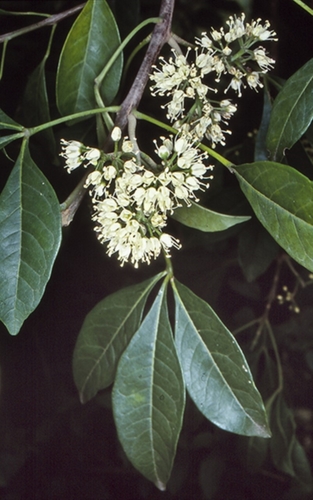
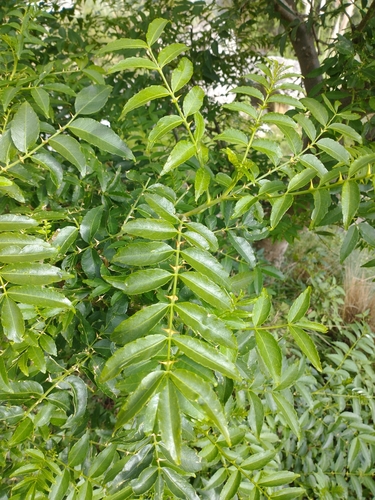
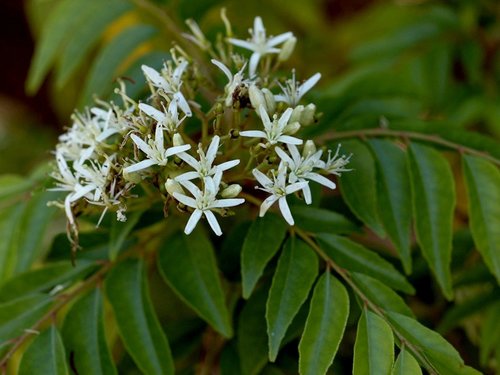
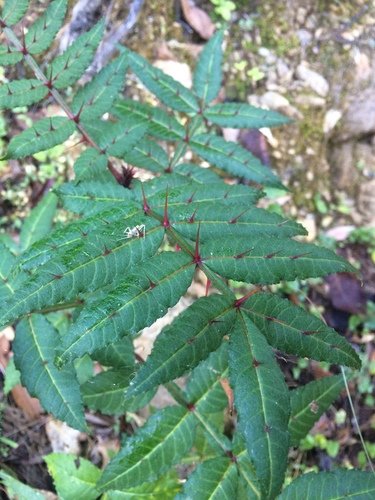
Zanthoxylum armatum DC. is a deciduous plant that grows as a woody climber, shrub, or tree, reaching a maximum height of 3.5 metres (11 feet). It bears opposite, subsessile leaves that can be lanceolate, obovate, or elliptic in shape. Both branchlets and leaves have prickles or spines. Young branchlets and inflorescence rachises are glabrous, or young branches are sparsely pubescent. The leaf rachis may be pubescent, glabrous, or rust-colored, and has wings up to 6 mm wide on each side. This winged leaf rachis is the source of its common English name, and is one anatomical feature that distinguishes Z. armatum from other species in the Zanthoxylum genus. Other distinguishing anatomical traits include generally faint secondary veins on leaflet blades, particularly on the adaxial side, with 7 to 15 secondary veins on each side of the midvein; male flowers have yellow anthers before anthesis; and female flowers have a 1-3-carpelled gynoecium. The plant’s fruit follicles are purplish-red, roughly 4 to 5 mm in diameter, while its seeds are black and measure 3 to 4 mm across. In China and Nepal, Z. armatum flowers from April to May, and fruits from August to October, though fruit is available year round in Nepal. In India, the plant flowers from March to April. Zanthoxylum armatum is native to parts of East Asia, Southeast Asia, and the northern Indian subcontinent, and has become naturalized in several additional regions. Confirmed regions where it occurs include Japan, the Nansei-shoto/Ryukyu Islands, Korea, North-Central, South-Central, and Southeast China (specifically Anhui, Fujian, South Gansu, Guangdong, Guangxi, Guizhou, South Henan, Hubei, Hunan, Jiangsu, Jiangxi, Shaanxi, Shandong, South Shanxi, Sichuan, Xizang, Yunnan, and Zhejiang), northern Taiwan, the Philippines, Vietnam, Laos, Thailand, Myanmar, Bangladesh, India (including Assam), Bhutan, Nepal, Tibet, the Eastern and Western Himalayas, Kashmir, Pakistan, and possibly Indonesia. It has been naturalized in Northeast Argentina and the North Caucasus. The variety Z. armatum var. ferrugineum occurs in North-Central, South-Central, and Southeast China, specifically in Guangdong, Guangxi, Guizhou, Hunan, Shaanxi, Sichuan, and Yunnan. Z. armatum grows in a wide range of habitats at elevations below 3100 m. In Nepal’s Salyan District, it grows in the understory of low-altitude Pinus roxburghii forests alongside Aesculus indica and Bassia latifolia, and in higher-altitude oak forests formed by Quercus incana and Q. lanuginosa, where it associates with Rhododendron arboreum and Lyonia ovalifolia. Birds feed on its fruits and widely disperse the plant’s seeds. The fruit and seeds of Z. armatum are used as a spice called timut pepper, which is related to Sichuan pepper but less pungent. The bark, fruit, and seeds are used in indigenous medicine in India, Nepal, and Thailand. The plant is also a source of an essential oil called Wartara Oil, and is cultivated as an ornamental garden plant. In Nepal’s Salyan District, medicinal plant material harvested from Z. armatum is primarily collected for export to India. Z. armatum grows on state-controlled, community-controlled, and private lands, leading to a variety of access, harvesting, and management regimes. This variation supports the conclusion that the effects of supply and demand on non-timber forest products (NTFP) cannot be generalized, and are instead specific to each product and location. Extracts from Z. armatum have been shown to inhibit the growth of Porphyromonas gingivalis, the main bacteria responsible for periodontal disease and a suspected cause of Alzheimer's disease.