About Zanthoxylum americanum Mill.
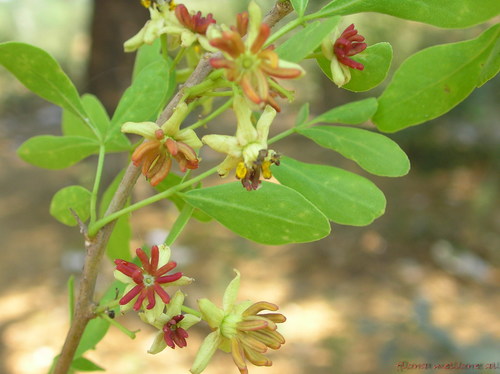
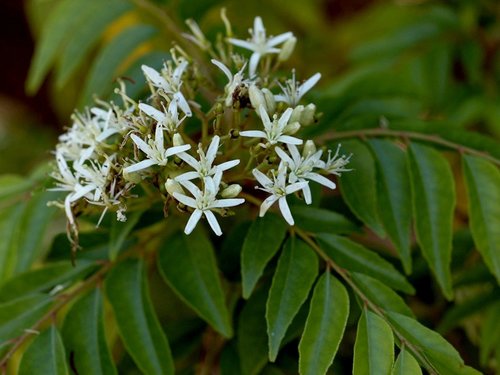
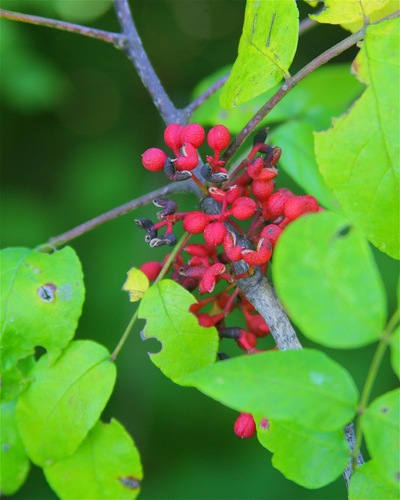
Zanthoxylum americanum Mill. has pinnately compound leaves with 5–11 membranous leaflets. Its dark green leaves are bitter-aromatic with crenate margins, and its buds are hairy. This plant produces axillary clusters of flowers and fruits. Flowers are dioecious, imperfect, and have yellow-green petals. They grow in small terminal to axillary umbellate umbrella-like clusters that each contain 2 to 12 flowers. Individual flowers have pedicels 2–4 mm long, 4–5 elliptic to ovate-oblong petals 1.6–1.9 mm long that are green with reddish hairs near the tips, 5 stamens, and an ovary with 2–5 carpels. Its stalked fruits are follicles that start green, then turn red, then deep blue, before finally maturing to black. Each carpel holds 2 seeds. This species is rare in the southern United States, and more common in the northern United States. It occurs across 40 U.S. states: Alabama, Arkansas, Connecticut, Delaware, District of Columbia, Florida, Georgia, Iowa, Illinois, Indiana, Kansas, Kentucky, Louisiana, Massachusetts, Maryland, Maine, Michigan, Minnesota, Missouri, North Carolina, North Dakota, Nebraska, New Hampshire, New Jersey, New York, Ohio, Oklahoma, Pennsylvania, Rhode Island, South Carolina, South Dakota, Tennessee, Virginia, Vermont, Wisconsin, and West Virginia. It also grows in the Canadian provinces of Ontario and Quebec. It is listed as Endangered in Florida, Maryland, and New Hampshire, and classified as Special Concern in Tennessee. It acts as a larval food source for three butterfly species: Thoas swallowtail (Papilio thoas), giant swallowtail (Papilio cresphontes), and spicebush swallowtail (Papilio troilus). This plant was known by the indigenous peoples of its native region, and was first documented for European audiences by John Bartram during his plant collecting travels and excursions. It grows in the understory of maple-oak woodlands, or in dense stands of small trees like evergreen oak. It is found on rocky, often shallow, well-drained tuff or other igneous rock, at elevations between 1,350–1,750 metres (4,430–5,740 ft). In its native habitat, the understory is dominated mainly by native bunchgrasses, mixed with other cacti and herbaceous species. In shaded, dense areas, ground vegetation is sparse, and the ground is covered in thick leaf litter. Zanthoxylum parvum flowers from late March to early April, before its leaves finish expanding. Although foliage is present for most of the year, this species is eventually deciduous, and its leaves turn yellow in mid-October. Modern scientific studies have examined the chemical constituents of the plant's oil, as well as the oil's antifungal and cytotoxic effects. In 2012, a distillery in Pennsylvania released a bitters called Bartram's Bitters that uses prickly ash bark as one of its botanical ingredients. This product is based on a recipe for "Bartram's Homestead Bitters" found in a book that once belonged to the family of botanist John Bartram.