About Zanthoxylum ailanthoides Siebold & Zucc.
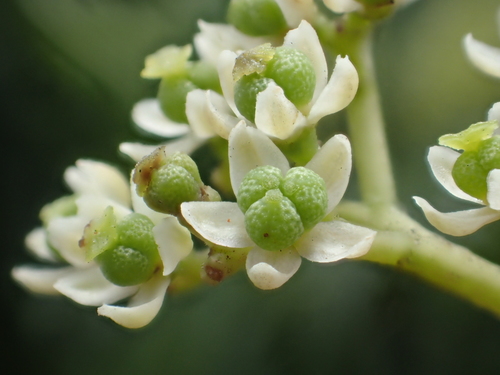
Zanthoxylum ailanthoides Siebold & Zucc., also known as ailanthus-like prickly ash, has multiple regional common names. In Chinese, it is called chun ye hua jiao (translated literally "Ailanthus-leaved pepper"), yue jiao (translated literally "Yue pepper"), and shi zhu yu. In Japanese, it is called karasu-zanshō and karasu-no-sanshō (translated literally "crow prickly ash"). It is an Asiatic plant in the prickly-ash genus Zanthoxylum, native to forested regions of southeastern China, Taiwan, Southeast Asia, and Japan from Honshu southward. Before the Columbian exchange, its piquant fruit was used as a local substitute for ordinary red pepper in China. In Taiwan, the young leaves of this plant are used in local cuisine. The name "Japanese prickly-ash" is sometimes applied to this species, but this terminology is confusing because the name is also used for Z. piperitum, the sanshō. Z. ailanthoides is not normally used for human consumption in modern Japan, with the exception of consumption by prehistoric Jōmon period people. Japanese macaques forage on this species in the wild. It has a regional nickname of tara, and its young shoots are often confused with true tara (Aralia elata) by wild plant gatherers. The species' specific epithet ailanthoides comes from its leaves resembling the leaves of Ailanthus. Like other plants in the rue family, it is a host food plant for the larvae of several Continental Asian swallowtail butterfly species, specifically Papilio bianor, Papilio helenus, Papilio protenor, and Papilio xuthus.