About Zamenis longissimus (Laurenti, 1768)
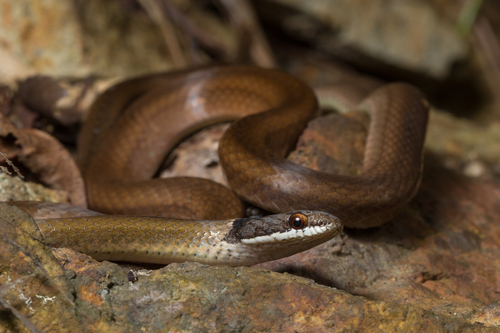
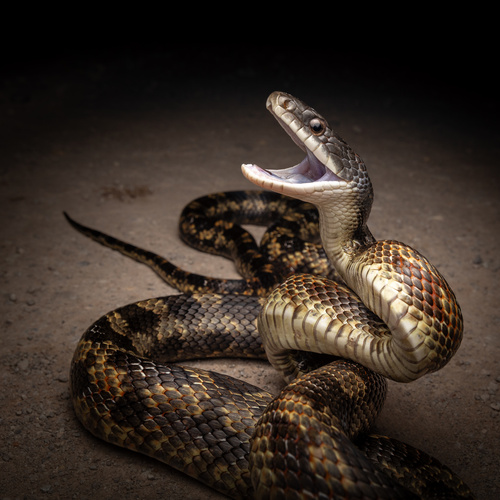
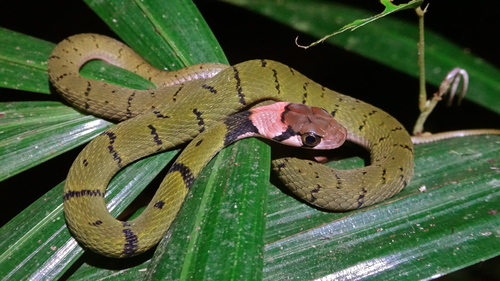
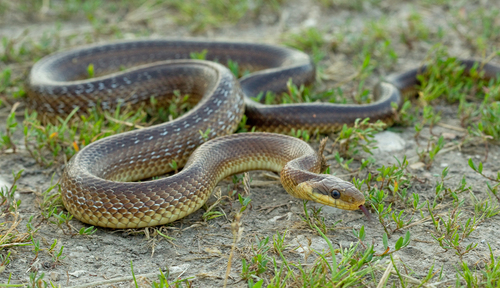
Zamenis longissimus, commonly known as the Aesculapian snake, hatches at approximately 30 cm (11.8 in) long. Adult total length, including the tail, usually ranges from 110 cm (43.3 in) to 160 cm (63 in), though they can reach 200 cm (79 in), and the recorded maximum size is 225 cm (7.38 ft). Adult body mass typically ranges from 350 to 890 g (0.77 to 1.96 lb). This species is a dark, long, slender snake that is typically bronzy in color, with smooth scales that create a metallic sheen. Juvenile Aesculapian snakes are easily confused with juvenile grass snakes (Natrix natrix) and barred grass snakes (Natrix helvetica), because juvenile Aesculapian snakes also have a yellow neck collar that may remain visible in younger adults for some time. Juvenile Z. longissimus are light green or brownish-green, with various darker patterns along their backs and flanks. Two darker lines run along the upper edges of the flanks. The juvenile head also has several distinct dark spots: one hoof-shaped spot on the back of the head between the yellow neck stripes, and two paired markings, one of which is a horizontal stripe that runs from the eye and connects to the neck marks, while the other is a short vertical stripe that connects the eye to the fourth or fifth upper labial scales. Adults have much more uniform coloration, which may be olive-yellow, brownish-green, or sometimes almost black. Adults often have a more or less regular pattern of white-edged dorsal scales that appear as white freckles across the body, sometimes forming moiré-like structures that enhance the shiny metallic appearance. Sometimes, especially in paler individuals, two darker longitudinal lines along the flanks can be seen. The belly is plain yellow to off-white, and the round iris is amber to ochre in color. Natural melanistic, erythristic, albinotic, and dark grey color forms are all known. While there is no obvious sexual dimorphism in coloration, males grow significantly longer than females, likely because females invest more energy into reproduction. For German populations, the maximum recorded weight is 890 grams (1.96 lb) for males and 550 grams (1.21 lb) for females. Like many other snake species, males also have a relatively longer tail relative to total body length and a wider tail base. At midbody, there are 23 dorsal scale rows (rarely 19 or 21), 211–250 ventral scales, a divided anal scale, and 60–91 paired subcaudal scales. Ventral scales have a sharp angle where the underside meets the side of the body, which improves the species' climbing ability. The estimated lifespan of Zamenis longissimus is 25 to 30 years. The currently recognized monotypic form of Zamenis longissimus, previously the nominotypical subspecies Zamenis longissimus longissimus, has a contiguous range that covers most of France except northern France (up to roughly the latitude of Paris), the Spanish Pyrenees, the eastern side of Spain's northern coast, Italy (excluding southern Italy and Sicily), the entire Balkan Peninsula down to Greece and Asia Minor, and parts of Central and Eastern Europe up to about the 49th parallel in the eastern part of the range, including Switzerland, Austria, South Moravia in the Czech Republic, Hungary, Slovakia, southern Poland, Romania, and southwestern Ukraine. Isolated populations have been found in western Germany (with one population near Passau connected to the contiguous range) and northwestern Czech Republic near Karlovy Vary, which is the northernmost known current natural occurrence of the species. There is also a separate enclave south of the Greater Caucasus along the Russian, Georgian, and Turkish northeastern and eastern shores of the Black Sea. Two additional enclaves are located around Lake Urmia in northern Iran, and on the northern slopes of Mount Ararat in eastern Turkey, roughly halfway between the Lake Urmia enclave and the Black Sea habitats. V.L. Laughlin hypothesized that parts of this species' distribution may be the result of intentional placement and later release by Romans from the temples of Asclepius, the classical god of medicine, where the snakes played an important role in medical rituals and worship of the god. The previously recognized subspecies Zamenis longissimus romanus, native to southern Italy and Sicily, was recently elevated to full species status as Zamenis lineatus, the Italian Aesculapian snake, which is lighter in color with a reddish-orange to glowing red iris. Populations previously classified as Elaphe longissima in southeastern Azerbaijan and the northern Iranian Hyrcanian forests were reclassified by Nilson and Andrén in 1984 as Elaphe persica, now Zamenis persicus. Fossil evidence shows that during the warmer Atlantic period of the Holocene, around 8000–5000 years ago, the species' range extended as far north as Denmark. Three specimens were collected in southern Zealand, Denmark, between 1810 and 1863, likely from a now extinct relict population. Genetic analyses indicate that the current northwestern Czech population is an autochthonous remnant of this earlier maximum distribution, and it is genetically closest to Carpathian populations; this likely also holds true for the German populations. Fossils also show that the species lived in the United Kingdom during earlier interglacial periods, but was pushed south by subsequent glacial periods. These repeated climate-driven range contractions and expansions across Europe occurred multiple times during the Pleistocene. The Aesculapian snake prefers forested, warm (but not hot), moderately humid (but not wet), hilly or rocky habitats with adequate insolation and varied, non-sparse vegetation that provides enough local microclimate variation to support thermoregulation. Across most of its range, it is typically found in relatively intact or moderately cultivated warmer temperate broadleaf forests, including more humid varieties growing along river valleys and riverbeds (but not marshes), as well as forest steppes. It commonly occupies sites such as successional forest clearings, shrublands at forest edges, forest-field ecotones, and woods mixed with meadows. It generally does not avoid humans, and is often found in gardens and sheds; it even prefers habitats like old walls, derelict buildings, and ruins that provide many hiding and basking spots. The synanthropic tendency is more pronounced in the northernmost parts of the range, where the species depends on human structures for food, warmth, and hatching grounds. It avoids open plains and agricultural deserts. In the south of its range, its distribution aligns with the boundary between deciduous broadleaf forests and Mediterranean shrublands, as the latter are likely too dry for the species. In the north, its range boundary is limited by temperature. Individuals of Zamenis longissimus reach the minimum length for entering the reproductive cycle at 85–100 cm (33–39 in), which corresponds to a sexual maturity age of around 4–6 years. Breeding occurs annually in spring after hibernation, typically from mid-May to mid-June. During this period, snakes actively seek one another before mating begins. Rival males take part in ritual fights meant to pin the opponent's head down with their own head or body coils; biting may happen but is not typical. Courtship consists of an elegant dance between the male and female, where the anterior portions of their bodies are held raised in an S-shape and their tails are entwined. The male may also hold the female's head in its jaws. Four to six weeks after mating, the female lays around 10 eggs, with a range of 2 to 20 and an average of 5 to 11, in a moist, warm spot where organic decomposition takes place. Common sites include under hay piles, in rotting wood piles, manure heaps, leaf mold, and old tree stumps. Especially in the northern parts of the range, multiple females often use the same preferred hatching grounds, which are also shared with grass snakes. The eggs incubate for approximately 8 weeks, ranging from 6 to 10 weeks, before hatching.