About Zalophus wollebaeki Sivertsen, 1953
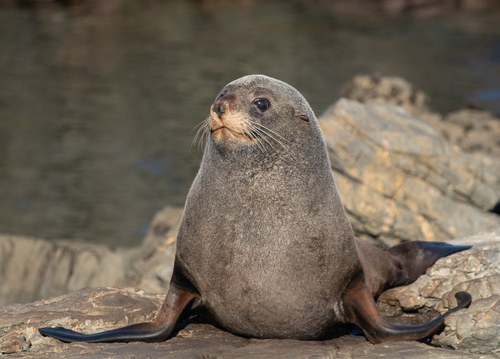
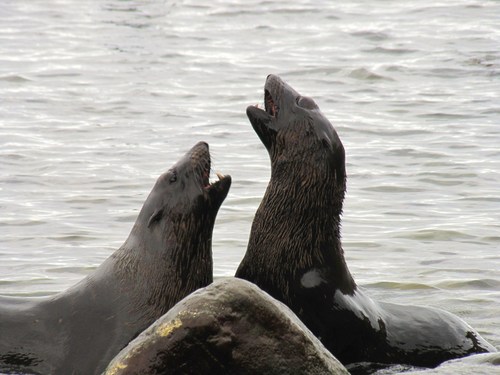
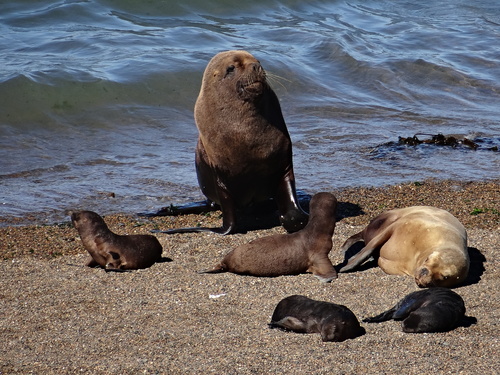
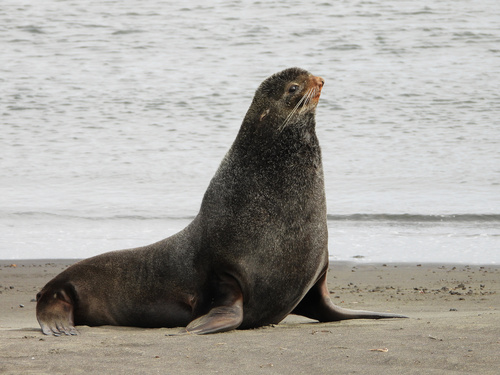
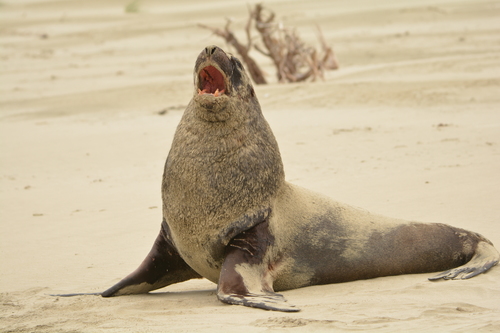
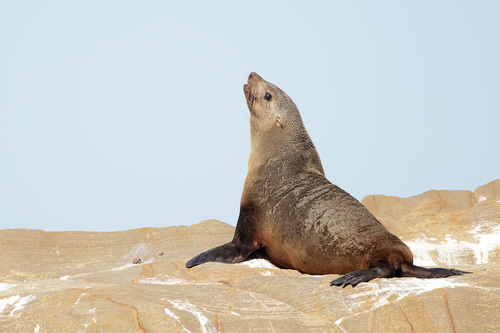
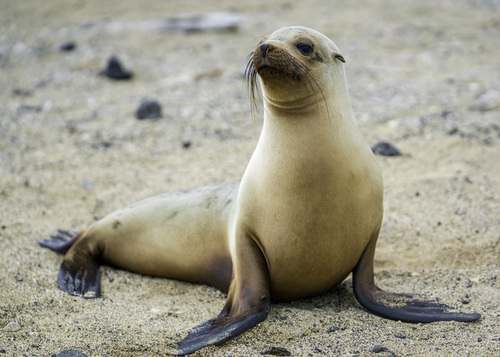
Galápagos sea lions (Zalophus wollebaeki) are slightly smaller than their closest relative, the California sea lion. Adults range from 1.5 to 2.5 meters (4.9 to 8.2 feet) in length and weigh between 50 and 400 kilograms (110 to 880 pounds), with males averaging larger than females. Sexual dimorphism has a small effect on this species' size and physical traits: males have thicker, more robust necks, chests, and shoulders paired with a slender abdomen, while females have longer, more slender necks and thick torsos. When males reach sexual maturity, their sagittal crest enlarges to form a small, characteristic bump-like projection on the forehead. Adult females and juveniles do not have this projection, and have a nearly flat head with little or no prominent forehead. Compared to California sea lions, Galápagos sea lions have a slightly smaller sagittal crest and a shorter muzzle. Both males and females have a pointy, whiskered nose and a long, narrow muzzle, while young pups have an almost dog-like profile. Like other sea lions, this species has external pinnae (ear flaps), a trait that distinguishes sea lions from true seals. The foreflippers have short fur that extends from the wrist to the middle of the dorsal fin surface; the rest of the flippers are covered in black, leathery skin. The first digit of the flipper is the largest and curves posteriorly, giving the flipper a swept-back look. A claw is present at the end of each digit, but it is usually reduced to a vestigial nodule that rarely emerges above the skin. While Galápagos sea lions are clumsy on land, they are agile in water. Their streamlined bodies and flipper-like limbs let them easily move through crashing surf and across sharp coastal rocks, and they can control their flippers independently to change direction easily. When wet, Galápagos sea lions are dark brown, but their color varies significantly once dry: females are typically a lighter shade than males, and pups are chestnut brown. Pups are born with a longer, brownish-black fetal coat called lanugo that gradually fades to brown within the first five months of life. At this point, pups undergo their first molt to grow their adult coat. Galápagos sea lions reach sexual maturity around 4 to 5 years of age, and their estimated life span is 15 to 24 years. This species is found on all main islands of the Galápagos archipelago, as well as on many smaller local islands. Less than a quarter of the total population lives on San Cristobal Island. Galápagos sea lions have also colonized Isla de la Plata, just off the coast of mainland Ecuador, and can be seen from the Ecuadorian coast north to Isla Gorgona in Colombia. There are recorded sightings of this species on Isla del Coco, which lies roughly 500 kilometers southwest of Costa Rica; the individuals found on Isla del Coco are considered vagrants.