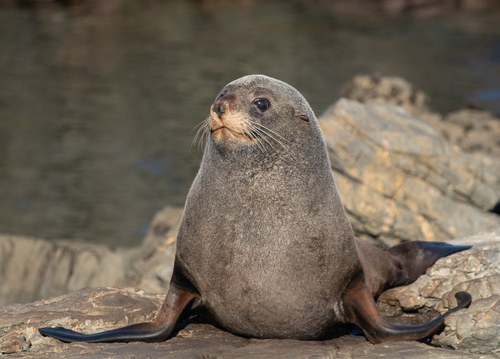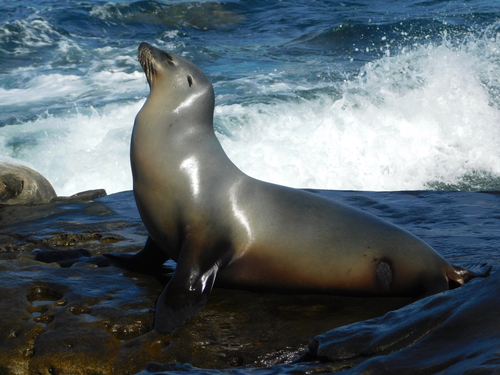
About Zalophus californianus (Lesson, 1828)
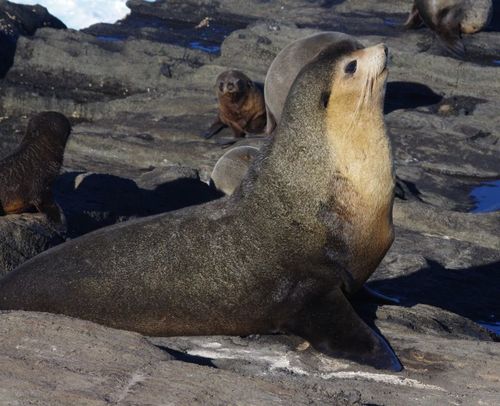
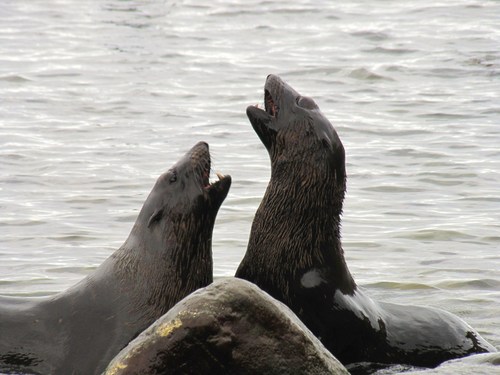
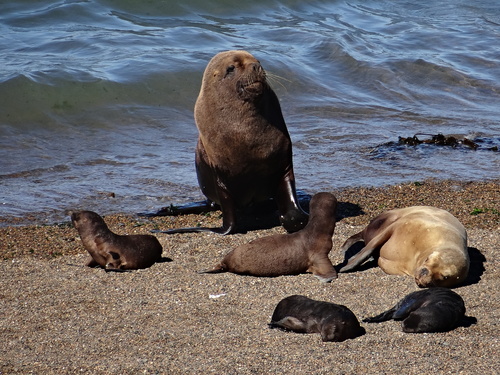
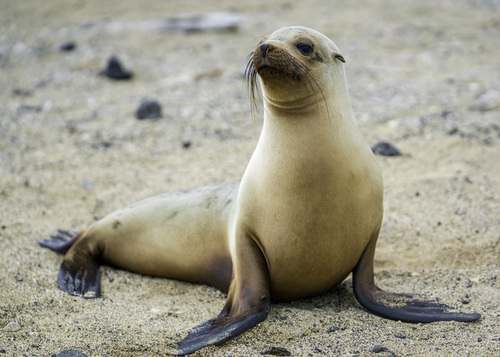
The California sea lion (Zalophus californianus) is a coastal eared seal native to western North America, and is one of six recognized sea lion species. Its natural range extends from southeast Alaska to central Mexico, including the Gulf of California. This species is sexually dimorphic: males are larger than females, have thicker necks, and a protruding sagittal crest. California sea lions primarily haul out on sandy or rocky beaches, but they also regularly use manmade environments such as marinas and wharves. They feed on a wide range of fish and squid species, and their main predators are orcas and great white sharks. California sea lions have a polygynous breeding pattern that runs from May to August. During this breeding season, males establish territories and attempt to attract females to mate with them. Females are able to move freely between territories and are not coerced by males. Mothers nurse their pups between trips out to forage for food. California sea lions communicate through a variety of vocalizations, most notably barks and specialized contact calls between mothers and their pups. Outside of the breeding season, California sea lions spend most of their time at sea, but come ashore to molt. California sea lions are notably intelligent, can be trained to complete many different tasks, and show limited fear of humans when they become accustomed to people. For this reason, they are a popular species for public display in zoos, circuses, and oceanariums, and the United States Navy trains them for certain military operations. The International Union for Conservation of Nature (IUCN) categorizes this species as Least Concern due to its large, abundant population. To protect fish stocks, the U.S. states of Oregon and Washington implement annual kill quotas for California sea lions. Along the western coast and islands of North America, the species' overall range stretches from southeast Alaska to central Mexico. A 2009 analysis of mitochondrial DNA sequences identified five separate California sea lion populations: the U.S. or Pacific Temperate stock, the Western Baja California or Pacific Tropical stock, and three distinct stocks within the Gulf of California: Southern, Central, and Northern. The U.S. stock breeds mainly on the Channel Islands, though some breeding sites have formed in northern California, and females are now commonly found in this northern area. The Western Baja California stock breeds primarily near Punta Eugenia and at Isla Santa Margarita. These two Pacific stocks are separated by the Ensenada Front. The Gulf of California stocks occupy distinct zones: the Northern stock lives in the Gulf's northern shallow waters, the Central stock occupies tidal islands near the center of the Gulf, and the Southern stock lives at the mouth of the bay. The status of California sea lions in the deep waters of the central Gulf of California has not yet been analyzed. Vagrant California sea lions can reach areas of the north-western Pacific, such as the Commander Islands. While several otariines have been recorded near the Japanese archipelago in recent years, their exact origins are unclear. During the breeding season, California sea lions gather on both sandy and rocky shores. On warm days, they rest closer to the water; at night or during cool weather, they travel further inland or to higher elevations. Non-breeding individuals may gather at marinas, wharves, or even navigational buoys. California sea lions can survive in fresh water for extended periods; one population lives near Bonneville Dam, nearly 150 miles (240 km) up the Columbia River. In 2004, a healthy California sea lion was found resting on a road in Merced County, California, almost a hundred miles upstream from San Francisco Bay and half a mile from the San Joaquin River.