About Yucca schidigera Roezl ex Ortgies
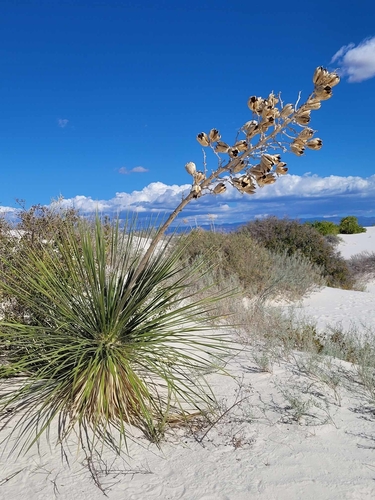
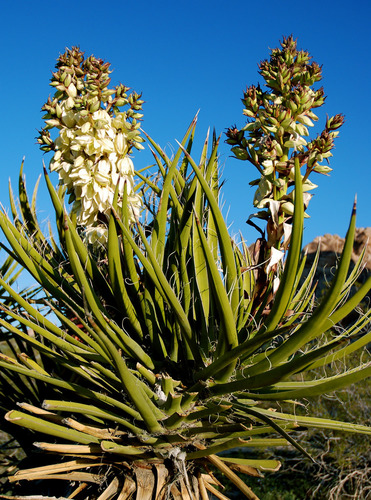
Yucca schidigera Roezl ex Ortgies is a small evergreen tree that reaches 5 metres (16 feet) in height. It has a noticeable basal trunk topped with a dense crown of spirally arranged, bayonet-like leaves. Its bark is gray-brown: near the top of the trunk, it is covered by brown dead leaves, while closer to the ground it becomes irregularly rough with a scaly to ridged texture. Individual leaves are 30–150 centimetres (12–59 inches) long and 4–11 cm (1+1⁄2–4+1⁄4 in) wide at the base; they are concavo-convex, thick, very rigid, and range in color from yellow-green to blue-green. The plant's flowers are white, sometimes with a purple tinge, and 3–5 cm (1+1⁄4–2 in) long, rarely reaching 7.5 cm. They are bell-shaped, divided into six segments, and grow in a compact, bulbous cluster 60–120 cm (24–47 in) tall that sits at the top of the stem. Its fruit is an elongated berry, growing up to 11.5 cm (4.5 in) in length.
This species is native to Arizona, Baja California, California, Nevada, and Utah. Within its native range, it occurs in the southernmost region of Nevada, Washington County in Utah, and the northwestern region of Arizona. It is most common in the Mojave Desert, but also widespread in the Sonoran Desert, extending west to the Pacific coast of southern California and into Baja California. Its southernmost distribution is in the Baja California desert. In the coastal portion of its range, it most often grows in association with Adenostoma fasciculatum (chamise). Yucca schidigera typically grows on rocky desert slopes and creosote desert flats between 300–1,200 m (980–3,940 ft) in altitude, and rarely occurs as high as 2,500 m (8,200 ft). It thrives in full sun and in well-draining soil, and requires no summer water. It is related to banana yucca (Yucca baccata), which grows in the same general area, and hybrids between the two are sometimes found.
After fire events, Mojave yucca readily produces sprouts, and seedling regeneration has been observed. Historically, the fire regime of its ecosystem was driven by large mature vegetation that carried fire. The introduction of invasive grass species, which are more fire tolerant, has increased fire frequency and altered the historical fire regime. Early records describe the Mojave Desert flora as arid grassland and shrubland communities that depended on winter precipitation. Yucca schidigera was tolerant of this historical fire regime and was rarely harmed. However, higher fire frequency caused by introduced nonnative grasses has lowered the survival rate of Yucca schidigera.
A specific moth species acts as its pollinator: moths collect pollen from the flowers, deposit it on a flower's stigma, then lay their eggs in the flower's ovary. The moth larvae feed on the growing fruit capsule, but leave some seeds intact to develop into mature fruit. Historically, Native Americans used fibers from Yucca schidigera leaves to make rope, cloth, thread, and sandals. The plant's flowers and fruit are eaten raw or roasted, and its black seeds were ground into flour. The roots are used to make soap. Some accounts note that Native Americans washed their hair with yucca to combat dandruff and hair loss. It has also been used to treat headaches, bleeding, gonorrhea, arthritis, and rheumatism.
Today, extracts from the plant are used in animal feed and a range of herbal medications. The mature rigid flower stalk is used as a substitute for eucalyptus stems or logs to make didgeridoos. It is also used as a natural deodorizer, including in pet deodorizers. Commercially produced steroid saponins from Yucca schidigera can be used as naturally derived food-grade surfactants. The plant is an ingredient in one quarter of all dog food sold, primarily to reduce the odor of pet waste. Research has found that ingestion of Yucca schidigera lowers blood cholesterol in humans and chickens, increases vitamin and mineral absorption in animals, and improves cattle reproduction rates. For farmed fish, Yucca schidigera extract provides multiple benefits: it improves fish growth rate by increasing protein metabolism, so less feed is needed to maintain fish populations. It also improves fish health by reducing ammonia levels in water, which improves overall water quality. Evidence also indicates that Yucca schidigera helps farmed fish resist common aquaculture diseases.