About Yucca glauca Nutt.
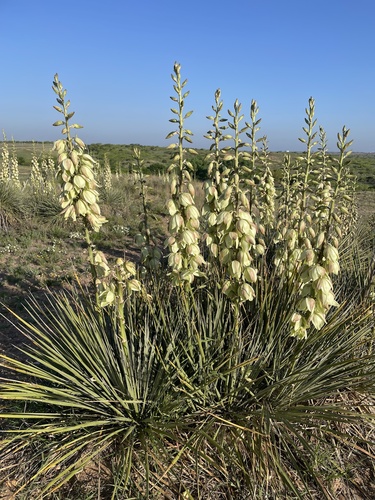
Yucca glauca Nutt., also synonymized as Yucca angustifolia, is a perennial evergreen plant adapted to dry, xeric growing conditions. Its common names include small soapweed, soapweed yucca, Spanish bayonet, and Great Plains yucca. This species grows in colonies of rosettes. Its leaves are long and narrow, reaching up to 60 cm in length but rarely exceeding 12 mm in width. The inflorescence can grow up to 100 cm tall, and may be either branched or unbranched. The flowers are pendent, meaning they droop and hang downward, and range in color from white to very pale green. It produces a dry capsule fruit that holds shiny black seeds. Yucca glauca is native to central North America. Its distribution extends from the Canadian Prairies of Alberta and Saskatchewan in Canada, south through the Great Plains to Texas and New Mexico in the United States. Soapweed yucca was a traditional medicinal plant for Native American tribes including the Blackfoot, Cheyenne, Lakota, and other groups. Among the Zuni people, boiled seed pods are eaten as food. Leaves are made into brushes used to decorate pottery, ceremonial masks, altars, and other objects. When soaked in water to soften, leaves can be knotted together to make rope. Split and plaited dried leaves are used to make water-carrying head pads. Leaves are also used to craft mats, cincture pads, and other goods. Peeled roots are pounded into a substance that creates suds, which is used to wash hair, wool garments, and blankets. Cooked young flower stalks and unripe fruits are also edible. Yucca glauca is a popular landscaping plant, especially suited for low-water and high-altitude gardens, and is an excellent choice for xeriscaping. This hardy perennial has showy leaves that create a striking visual display, and it is both cold hardy and drought tolerant. Its typically cream-colored bell-shaped flowers grow on tall spikes, and the plant blooms during the summer. It is also deer resistant. Yucca glauca can be propagated from winterized seed, root cuttings, and stem cuttings. The tips of its leaves are sharply needle-like, so the plant must be handled with care, and it is recommended to plant it away from areas with frequent foot traffic.