About Yucca brevifolia Engelm.
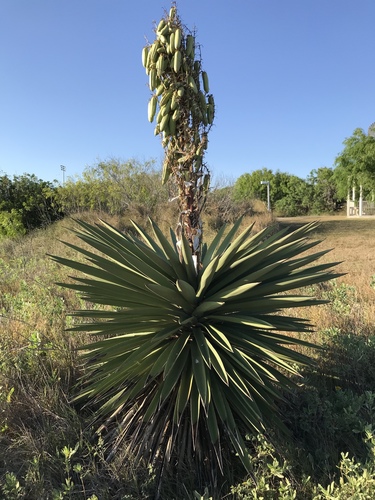
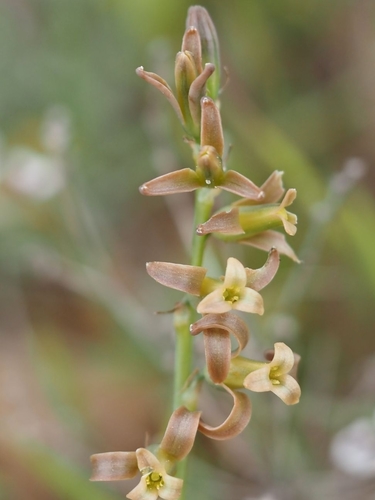
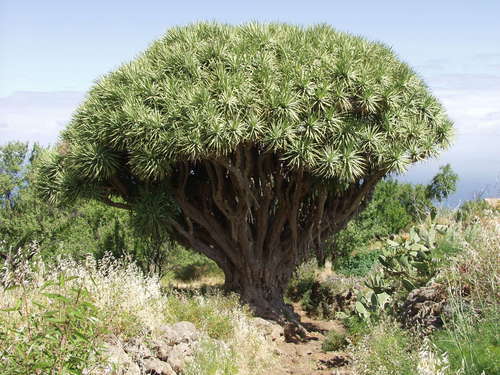
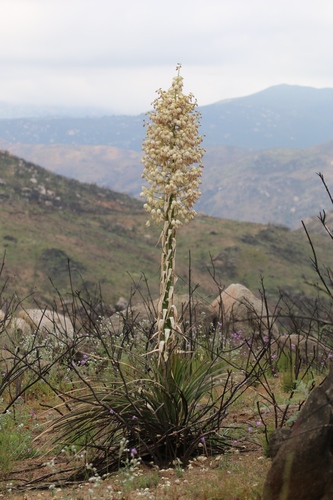
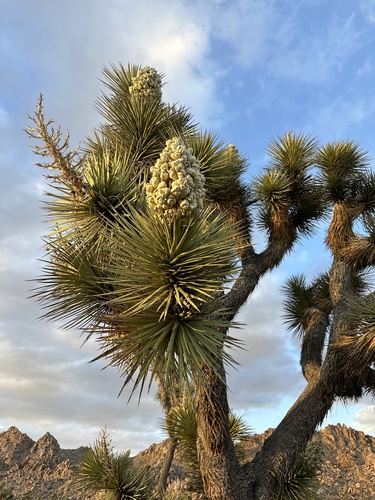
Yucca brevifolia Engelm., commonly called the Joshua tree, yucca palm, tree yucca, and palm tree yucca, is a tree-like species in the Yucca genus. This monocotyledonous tree is native to the arid Southwestern United States (California, Arizona, Utah, and Nevada) and northwestern Mexico. Most of its population is confined to the Mojave Desert, at elevations between 400 and 1,800 m (1,300 and 5,900 ft), and it is considered one of the major indicator species of this desert. It grows particularly well in the open grasslands of Queen Valley and Lost Horse Valley within Joshua Tree National Park. Large populations are also found in other locations: northeast of Kingman, Arizona in Mohave County; along U.S. 93 just south of Meadview, Arizona, where the route is designated the Joshua Tree Parkway of Arizona; and in Saddleback Butte State Park, located 135 kilometres (85 miles) north of Downtown Los Angeles in the Antelope Valley of Los Angeles County. The widespread common name Joshua tree comes from Christian iconography. Multiple cultivated varieties of Yucca brevifolia exist, including smaller forms native to the eastern part of the species’ natural range. These smaller plants reach 2.5 metres (8 ft 2 in) in height and begin branching when they are around one metre (3 ft 3 in) tall. Red-shafted flickers build nests in the branches of Joshua trees, and these nests are later reused by other bird species. Although native to a desert climate, Joshua trees can tolerate temperatures as low as −18 °C (0 °F). Their successful planting in Denver, Colorado indicates they may also survive occasional temperatures as cold as −23 °C (−9 °F). Before the 20th century, Native Americans living in the Mojave and western Sonoran Desert regularly used various parts of the Joshua tree for food and fiber. Leaf fibers were occasionally used to bind and make sandals. Root sheaths were woven into baskets to create reddish-brown patterns. Fruits were baked or boiled before being eaten. Seeds were ground into flour, mixed with flour from other plant species, moistened with water, kneaded into cakes, and dried.