About Yucca aloifolia L.
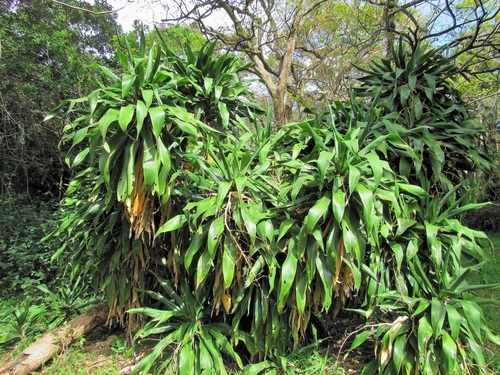
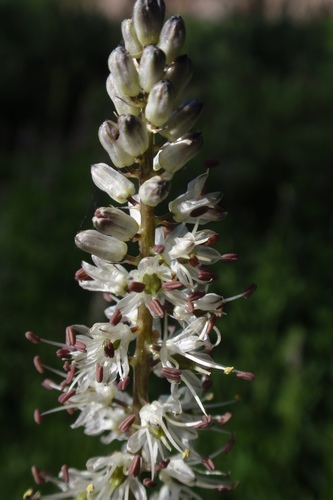
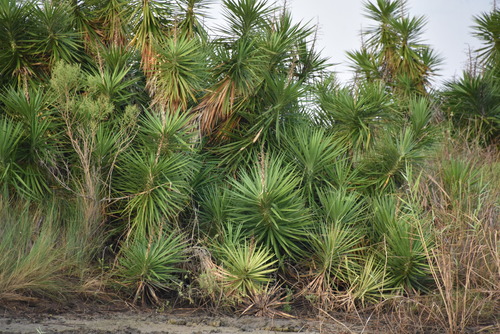
Yucca aloifolia L. has an erect trunk with a diameter of 3 to 5 inches (7.6 to 12.7 cm), which grows to 5 to 20 feet (1.5 to 6.1 m) tall before becoming top heavy and toppling over. Once toppled, the tip of the trunk turns upward and continues growing. The trunk is covered in sharp, pointed, strap-shaped leaves with fine-toothed edges; each leaf grows to approximately 2 feet (0.61 m) long. Young leaves near the growing tip stand upright, while older leaves bend reflexed downward. The oldest leaves wither, turn brown, and hang around the lower trunk in a formation similar to a Hawaiian skirt. Eventually, the trunk tip grows a 2 foot (0.61 m) long spike of white flowers with purple tints; each individual flower is roughly 4 inches (12.7 cm) across. After flowering, the original trunk stops growing, but one or more lateral buds develop quickly, with the uppermost bud growing into a new terminal shoot. This species also produces new buds or offshoots near the base of the trunk, forming the thickets that are commonly seen in dry sandy scrub beach areas of the southeastern United States. Yucca aloifolia produces showy white flowers that are sometimes tinged purple, making this plant a popular ornamental species. Its fruits are elongated and fleshy, and can reach up to 5 cm in length. It is widely planted in hot climates and arid environments, and has a maximum lifespan of 50 years. Yucca aloifolia is native to the Atlantic and Gulf Coasts of the United States, ranging from southern Virginia south to Florida, and west to the Texas Gulf Coast. It is also native to the Yucatán coast of Mexico, Bermuda, and parts of the Caribbean. It is typically grown in USDA hardiness zones 8 through 11, and is a common landscape plant in beach areas along the lower East Coast of the United States from Virginia to Florida. It has become naturalized in the Bahamas, Argentina, Uruguay, Italy, Pakistan, South Africa, Queensland, New South Wales, and Mauritania, and is common in gardens and parks across the Iberian Peninsula (Portugal and Spain). For uses, birds and humans both eat the fruit of Yucca aloifolia, and its flowers can be eaten cooked or raw. Roots of this species can be used to make soap and shampoo.