About Yersinella raymondii (Yersin, 1860)
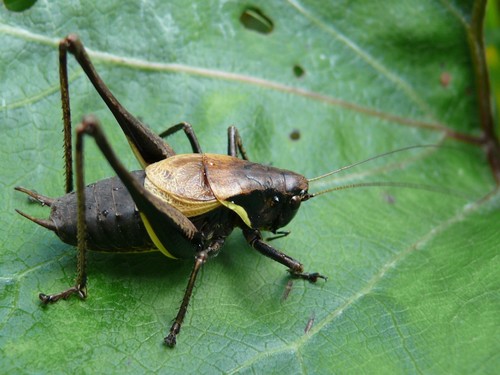
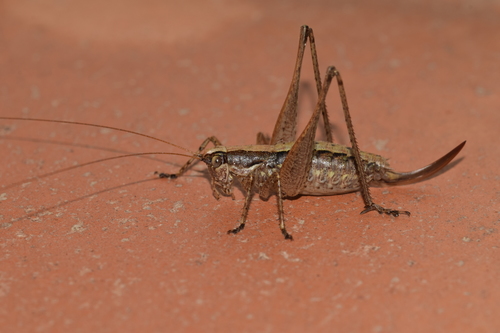
Yersinella raymondii is a relatively small bush-cricket species. Adult males reach 12–16 millimetres (0.47–0.63 in) in length. Females can grow up to 25–26 millimetres (0.98–1.02 in) when their ovipositor is included; this ovipositor is relatively conspicuous, measures 8–11 millimetres (0.31–0.43 in), and curves slightly and evenly upward. The basic body color of Yersinella raymondii usually ranges from gray to chestnut to reddish brown. Females are often brighter and have less color contrast than males. A broad, longitudinal dark gray or dark brown band runs along the sides of the body. The dorsal surface of the body is light gray or light brown, marked with two longitudinal brown lines. The species has dark brown compound eyes, and antennae that are longer than the body. The pronotum is flattened, extended toward the rear, and has whitish or yellowish bands along the lower edge of its lateral margins. Female Yersinella raymondii have reduced wings that only extend just below the pronotum. Males have larger wings, which extend beyond the pronotum by at most half the pronotum's length. The abdomen is long and thick. The legs are brown with darker markings on the knees, and short thin spines on the tibiae of all leg pairs. Male cerci are slightly flattened and lack an inner tooth. Due to their small size and barely visible wings, Yersinella raymondii is often incorrectly mistaken for a nymph of another grasshopper species, or for Rhacocleis germanica. It can be easily distinguished by the characteristic flattened cerci of males, and by the clear contrasting stripe pattern on its back and body sides. This fairly common species is mainly found in Albania, Austria, Bosnia and Herzegovina, Croatia, France, Hungary, Romania, Italy, Greece, Serbia, Slovakia, Slovenia, Spain and Switzerland. These katydids primarily inhabit forest edges, open forests, and Mediterranean shrubland, at elevations up to 1,600 metres (5,200 ft) above sea level. They live in hilly and mountainous areas, prefer shrubs, low herbaceous plants, or the ground over tall grasses, and occupy open areas with abundant vegetation.