About Xysticus ulmi (Hahn, 1831)
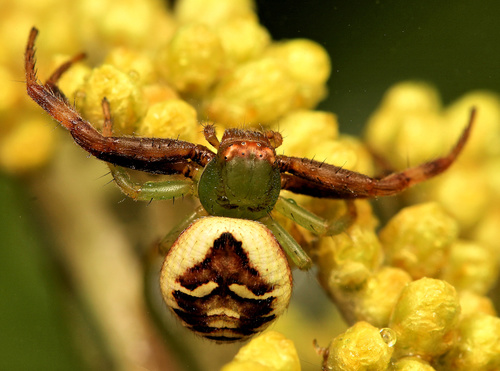
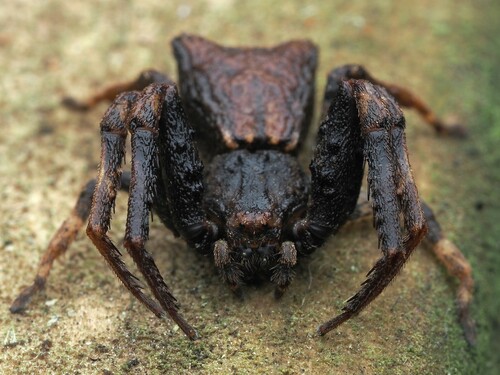
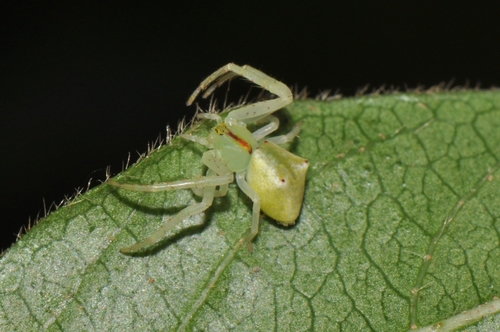
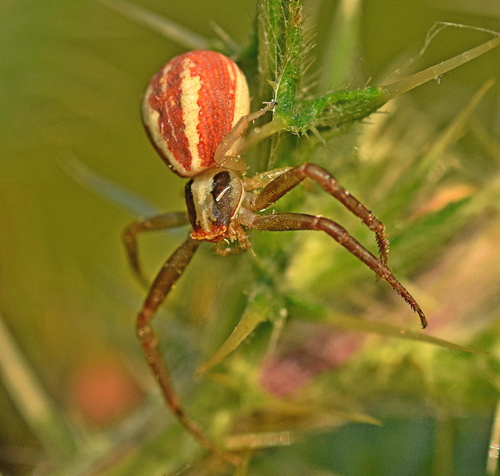
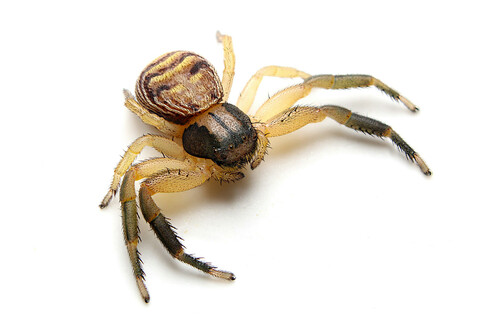
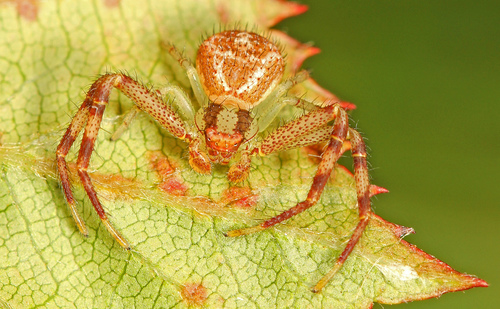
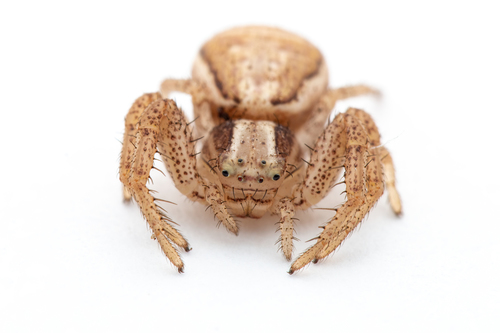
Males of Xysticus ulmi have a body length of 3–4 mm, while females reach 5–8.3 mm. Compared to other Xysticus spiders, the triangle on the carapace and the entire abdomen of this species are much more elongated. The leaf-like dorsal pattern (called the folium) is brownish, with faint whitish transverse lines toward the posterior end of the abdomen. The legs are marked with fine spots. Xysticus ulmi is sexually dimorphic: males are darker than females, and the patella and femora of their first and second legs are black. Xysticus ulmi is most commonly found on low vegetation and in the ground layer of damp locations, particularly in wetlands and rough grassland. It can also occur in ditches alongside arable fields, hedges, roadside verges, and open woodland areas where the canopy is not closed, such as coppiced sites. In Europe, it occurs from lowland elevations up to alpine regions. Xysticus ulmi has a Palearctic distribution. It is found across most of Europe, but is absent from Iceland. In Britain, it avoids very dry areas, and becomes less common further north in Scotland.