About Xylotheca kraussiana Hochst.
Taxonomic Classification
Xylotheca kraussiana Hochst. is an African shrub or small multi-stemmed tree classified in the plant family Achariaceae.
Distribution
It grows in sandveld and is widely distributed across the eastern regions of Southern Africa, particularly in eastern Transvaal, coastal Natal, and Mozambique.
Habitat and Soil Preference
It prefers the sandy soils found in coastal bush and coastal forest.
Etymology of Generic Name
The generic name 'Xylotheca' translates to 'woody case', while the specific epithet kraussiana honours Dr C.F.F. Krauss (1812–1890), a German naturalist who later became director of Stuttgart's Natural History Museum.
Namesake Collection History
Krauss arrived at the Cape in 1838, and collected plant specimens in Natal from 1839 to 1840.
Congeneric Species Range
Approximately 8 other species within the genus Xylotheca occur in central Africa and Madagascar.
Leaf Characteristics
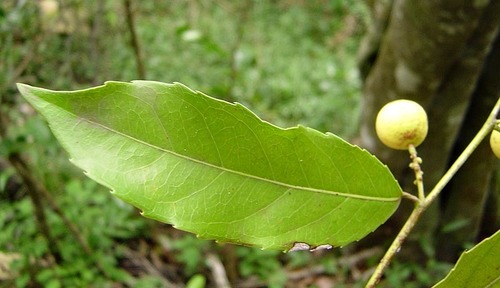
The leaves of this species are dull grey-green, grow in an alternate arrangement, and are covered in soft grey hairs.
Flower Characteristics
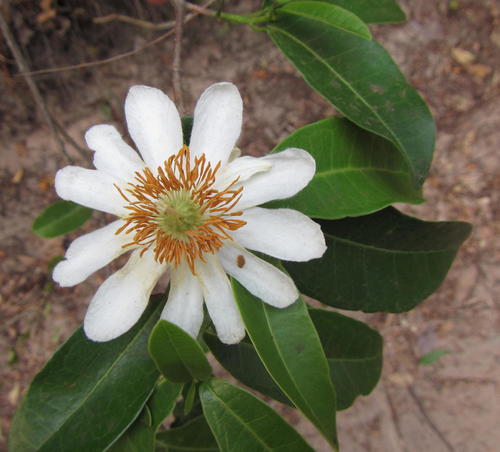
Its flowers are white, with a dense central cluster of yellow anthers, and resemble a small white rose.
Unripe Fruit Characteristics
The fruit is an ovoid woody capsule roughly 40 mm (1.6 inches) long with distinct surface ridges.
Ripe Fruit and Seed Characteristics
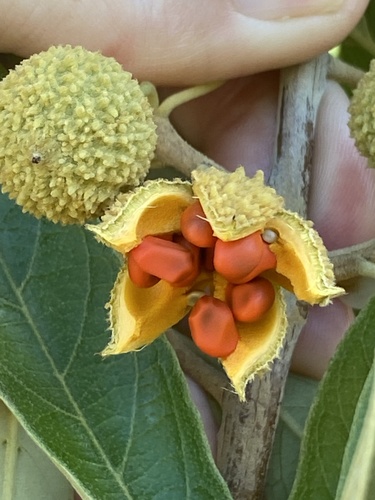
When ripe, the fruit is yellow, and it partly splits into five sections to reveal black seeds each covered with a bright red aril.
Seed Dispersal Interaction
Birds relish the pulp that surrounds these seeds.
Historical Taxonomic Placement
This species was previously placed in the family Flacourtiaceae, before being moved to Achariaceae by the Angiosperm Phylogeny Group.