About Xylocopa virginica (Linnaeus, 1771)
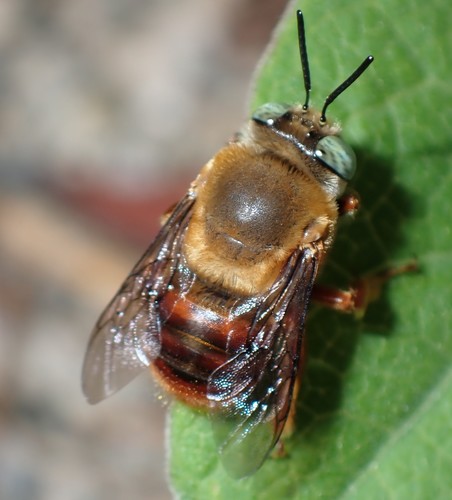
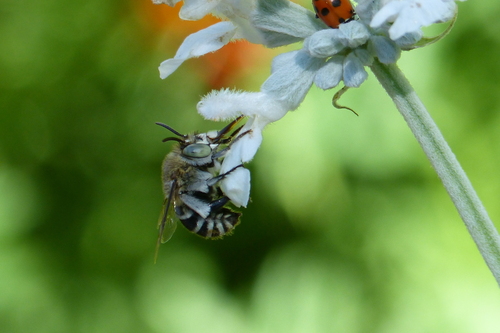
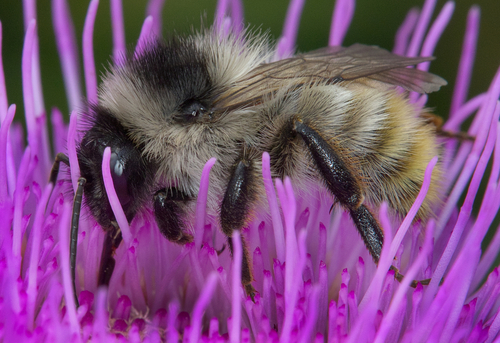
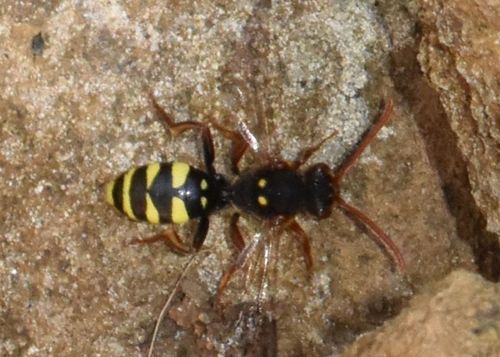
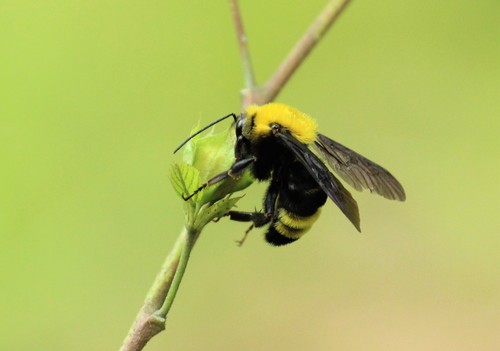
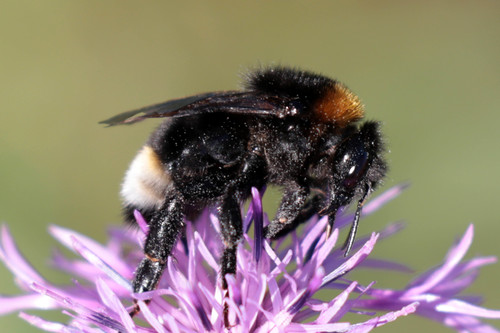
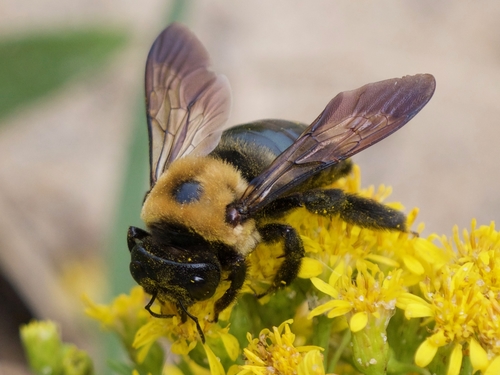
Description and identification: Xylocopa virginica is similar in size to bumblebees, with a glossy, mostly black body that has a faint metallic purple tint. Males and females of this species have roughly the same mass, but they can be told apart visually: males have longer bodies, while females have wider heads. Males also have a white spot on the face, and have larger thoracic volumes for their given body mass. Females of different social standing can also be distinguished by their physical traits: primary females are larger than secondary or tertiary females, and show more mandibular and wing wear. This species has distinctive maxillae adapted to make perforations in corolla tubes to reach nectaries. The maxillae are sharp and wedge-shaped, letting the bee split the outer side of corolla tubes to access nectar. Eastern carpenter bees have galeae on their maxillae shaped like large, flat blades; bees with sharp galeae can use these structures to further help penetrate corolla tubes. Distribution: Xylocopa virginica occurs across most of North America east of the Rocky Mountains, and ranges at least as far north as Nebraska, southern Ontario, and Maine. Life cycle: Mating in Xylocopa virginica happens only once per year, in spring. Eggs are laid in July, starting from the section of the nest farthest from the exit hole. By around August to mid-September, larval development finishes and all pupae have reached adulthood. Researchers propose there is a mechanism that synchronizes emergence time for young laid at different dates, by causing younger eggs to develop more quickly. This mechanism stops bees that would emerge earlier from killing their siblings to reduce competition. Newly emerged bees have a soft cuticle and white wings; the wings later turn brown, then bluish black. They are able to fly 3–4 days after emergence, but stay in their nest for at least two weeks, consuming nectar but not pollen. Juveniles start the next mating cycle the following spring, so one generation develops per year. Females start showing signs of senescence around July. Characteristic senescent behavior includes resting in flowers, staying in the nest, or even falling to the ground mid-flight. Older individuals also crawl instead of flying, avoid flight altogether, and do not struggle when handled by humans. Old bees die by early August, which is the same time that juveniles emerge from their brood cells. Because old bees die and new bees emerge at the same time, there is very little overlap between generations, except for some females that survive a second winter.