About Xylocopa sulcatipes Maa, 1970
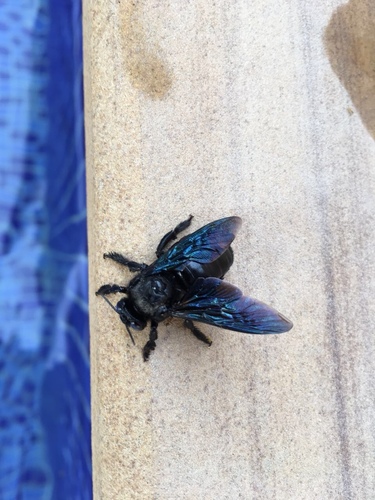
Xylocopa sulcatipes Maa, 1970 is a large Arabian carpenter bee that can be distinguished from other Arabian carpenter bees by several physical traits. Females can be identified by black pubescence, meaning short matted hairs, on the face and the back side of the mesosoma. The female mesoscutellum, a middle body shield, does not extend over the metanotum, the middle thorax. The apical margin, the lower part of the abdomen, is rounded rather than squared off, and these bees have a plate on the pygidium, the lowermost abdominal section. Males have dark to black pubescence covering their entire bodies except for their faces. The middle section of the male back is mostly light or pale. The first metasomal tergum, the back segment, has a subhorizontal dorsal surface that curves into the anterior surface. Eggs of this species measure approximately 11 mm in length and 2.2 mm in diameter. Adult X. sulcatipes reach around 22 mm in total body length. This species has been recorded in Saudi Arabia, Yemen, Israel, Egypt, and Transcaspia. It nests in cane or thin-branch structures, using locally available native plant materials for nesting, so nesting materials can vary. Accepted nesting substrates include dead branches, sticks, dead flowering stalks of Ferula spp., and other suitable soft, wooden, tubular objects abandoned by humans. Nest entrance holes are approximately 1.2 cm wide, while the internal tunnels range from 1.2 to 1.6 cm wide and are at least 12 cm long. This bee constructs nests using multiple different methods. One method involves a female cutting a hole along the side of the nesting material, entering it, and excavating the nest along the grain in one or both directions; this often involves burrowing into substrate that requires little or no extra digging. A second method is gaining entry to the substrate by cutting into an existing cut surface or broken cross-section. Once the nest structure is complete, females linearly layer the nest walls with pollen and nectar, place an egg into the prepared food mass, and finally seal off the nest. Nests can be located in dead branches on the ground or hung cut wood above ground, but they are most commonly found in partially shaded areas.