About Xylocopa micans Lepeletier, 1841
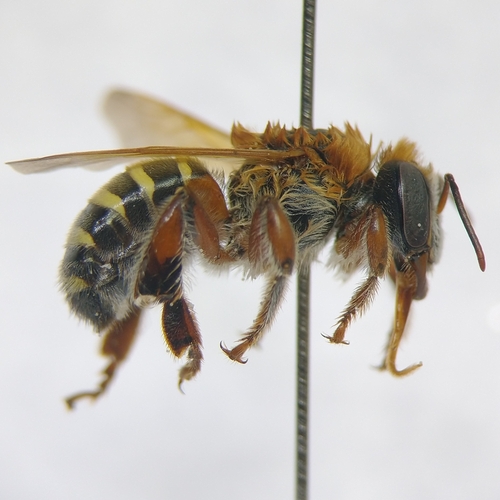
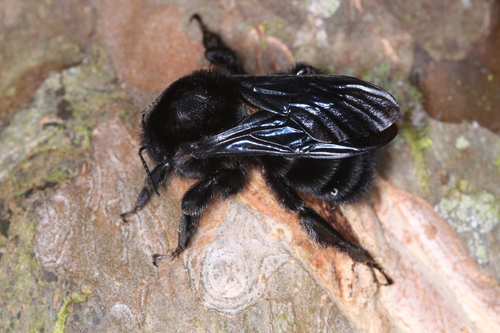
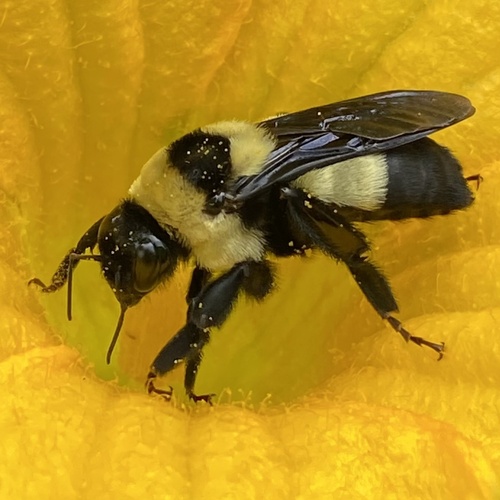
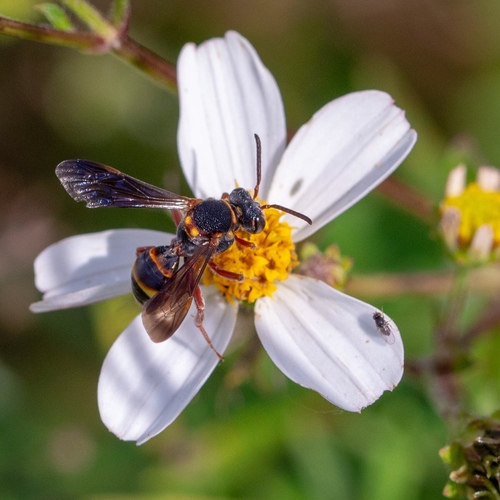
Xylocopa micans, the southern carpenter bee, is a large species of carpenter bee. Adults measure 15 to 19 millimetres (0.59 to 0.75 inches) in length, and 8 to 9 millimetres (0.31 to 0.35 inches) in width. Its body is generally metallic black, with blue or green iridescent tinges when reflecting light. This species has a flat clypeus, relatively short mandibles, and lateral ocelli positioned below the top of the head. Both males and females have short, dense pubescence on the head. Though males and females are largely monomorphic, they differ in the amount and color of body hair covering. Females have sparse dark pubescence on the scutum and scutellum, while males have dense bright yellow pubescence on these same structures. Females have completely bare first through fourth terga, with white hair tufts on the fifth and sixth terga. Males have yellow pubescence covering the entire first and second terga, and black pubescence on the third through sixth terga.
Like other species in the Xylocopa genus, X. micans builds nests by excavating into woody plant material, most commonly the dead wood of almost any tree species. However, wild nests of this species have only rarely been observed. Females use their strong mandibles to vibrate and cut holes into wood, then burrow to create a nest approximately 8 mm in diameter. Several brood cells are spaced along the full length of the nest, which measures roughly 12 cm in total length.
X. micans is distributed across the southeastern United States, occurring in coastal states from southeastern Virginia south to Florida, and west along the Gulf Coast to Texas. Its range extends further south through Mexico, reaching as far as Guatemala. In some regions, such as the Lower Rio Grande Valley, this bee is only active and found during warmer months, but it can be found year-round in most parts of its range. Specimens of X. micans have also been found as far north as Prairie County, Arkansas. Two hypotheses have been proposed to explain this northward occurrence: one is that it reflects climate change-driven species range shifts, which have also been observed in the Edith's checkerspot butterfly. The alternative hypothesis is that this northward presence is caused by human activity, since Arkansas specimens were mostly found near Interstate 40; X. micans may burrow into commercial lumber that is then transported hundreds of miles north.