About Xylocopa latipes (Drury, 1773)
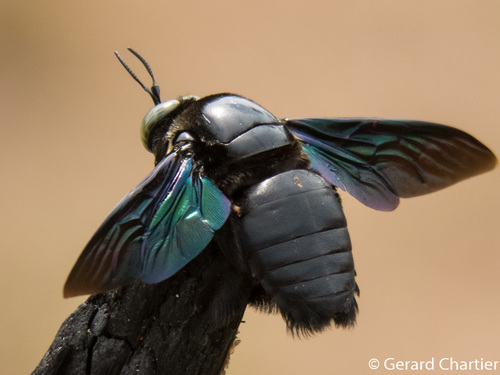
Xylocopa latipes, commonly called the broad-handed carpenter bee, is a carpenter bee species widely distributed across Southeast Asia. It lives in forests and builds nests by burrowing into wood. It typically creates long, deep tunnels in wooden rafters, fallen trees, telephone poles, and similar materials, and does not inhabit living trees. This species was first formally described by English entomologist Dru Drury in 1773, and belongs to the carpenter bee group within the family Apidae. The broad-handed carpenter bee is a very large, robust solitary bee. Its body is shiny and completely black, and its wings show fuscous metallic blue-green or purple coloring when viewed in sunlight. This species is counted among the largest known Xylocopa, and is also one of the largest bees in the world, though it is not the world's largest bee—that title is held by Megachile pluto, another Southeast Asian bee from Indonesia. It produces a loud, distinctive low-pitched buzzing that can be heard when it flies between flowers or perches. In urban areas, these bees may become associated with specific perches, returning to them every day across multiple generations. In the Philippines, this species of carpenter bee is used commercially to pollinate passion-fruit flowers. It naturally carries out this pollination function in Indonesia, Malaysia, and other parts of Southeast Asia. Additionally, passion-fruit flowers (Passiflora edulis flavicarpa) have been observed to bloom in sync with the foraging rhythms of these carpenter bees, which suggests a developing evolutionary relationship between the two.