About Xylocopa bombylans (Fabricius, 1775)
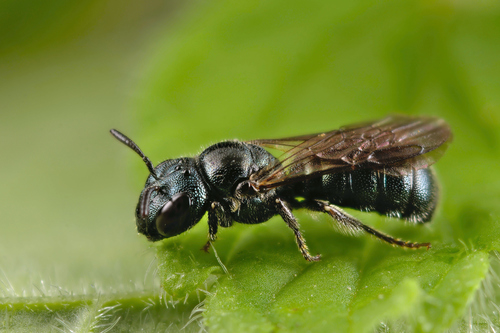
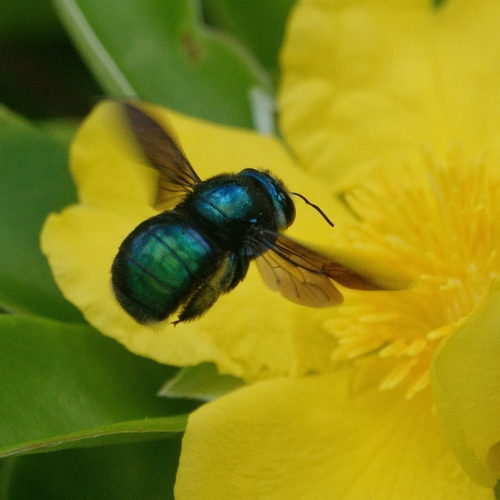
Xylocopa bombylans, commonly known as the peacock carpenter bee, is a species of carpenter bee that occurs in Australia. It gets its common name from its habit of burrowing into wood. The species was first formally described by Danish naturalist Johan Christian Fabricius in 1775. Its specific epithet, bombylans, is Latin for "like a bumblebee", while its generic name comes from the Ancient Greek word ξυλοκόπος (romanized: ksulokópos), meaning "wood-cutter". As its common name suggests, the peacock carpenter bee has a metallic blue-green or green body colour, and may even appear purplish when viewed from some angles. It is a large, stocky bee, and is often noticeable by its loud low-pitched buzzing as it flies between flowers. Males have white markings on their faces. While this species has a potentially painful sting, no stings have ever been recorded. Its natural distribution ranges from Cape York Peninsula in northern Queensland, south along the eastern seaboard to the Sydney region, where its range overlaps with that of X. aerata. Adult peacock carpenter bees can be seen from spring to autumn. They commonly feed on pea flowers in the family Fabaceae, such as Gompholobium species—including Gompholobium latifolium in spring—and Pultenaea elliptica in autumn. It is a known pollinator of Melastoma affine. Other flowers it visits include those of Banksia, Xanthorrhoea, Hardenbergia violacea, Tristania, Leptospermum, Aotus, Cassia, and Leucopogon. The peacock carpenter bee nests by hollowing out stalks of grasstrees (Xanthorrhoea) or soft wood from genera including Banksia, Casuarina, Melaleuca, and Leptospermum. Females excavate tunnels with their jaws, carrying and discarding the resulting wood shavings outside the nest. The hollowed tunnel can reach 30 centimetres (12 inches) in length, with a diameter between 11 and 14 millimetres (0.43 to 0.55 inches). Larger pieces of wood may accommodate multiple tunnels. Multiple female bees may share a single nest, with one breeding and the others acting as guards. A bee defends the nest entrance, which is 7 to 10 millimetres (0.3 to 0.4 inches) wide, by blocking it with its abdomen. Both male and female peacock carpenter bees may overwinter inside the tunnels. Tunnels are divided into multiple separate cells; the mother bee lays a single egg in each cell and provisions it with nectar and pollen.