About Xylocarpus granatum J.Koenig
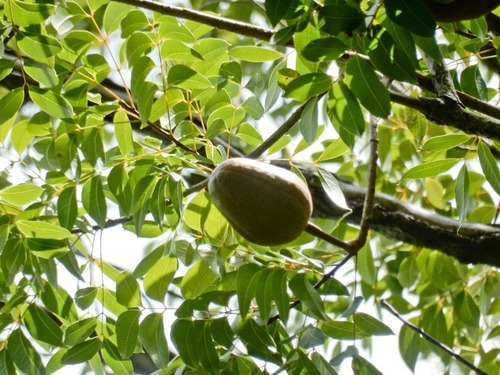
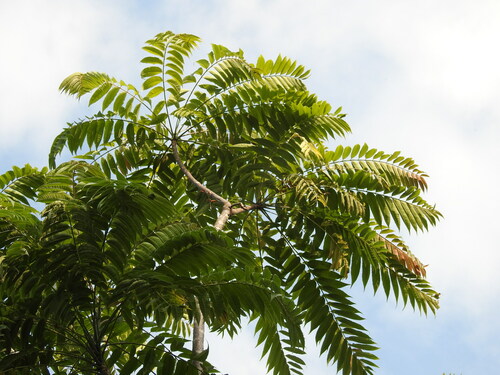
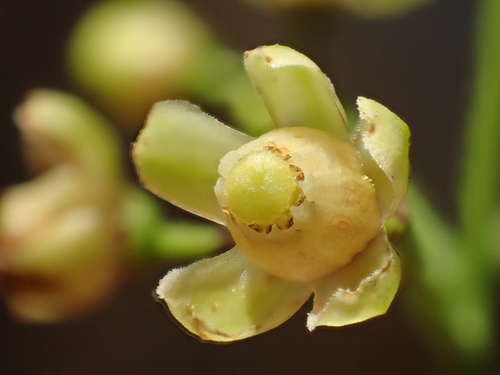
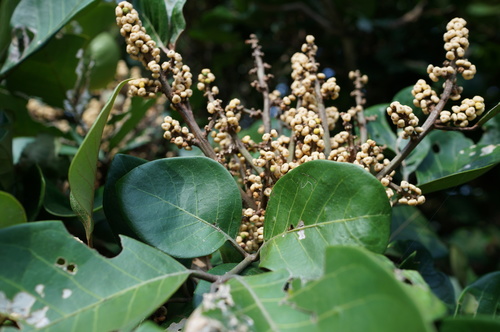
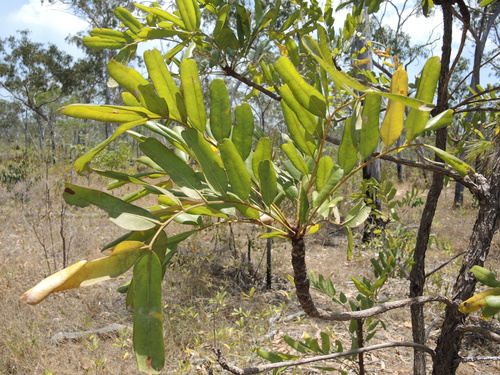
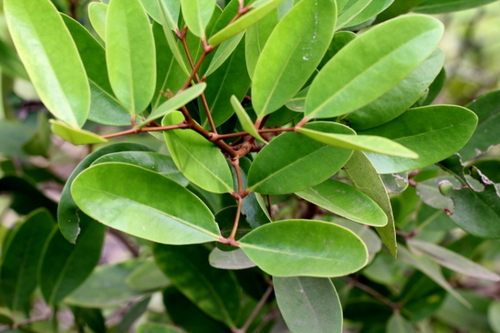
Xylocarpus granatum J.Koenig is a small to medium-sized evergreen tree, reaching a maximum height of 12 meters (39 feet). Its trunk features buttresses, and it produces above-ground roots that extend long distances to either side. The bark is brown and smooth, and it peels away in flakes. Its leaves are pinnate, arranged spirally on twigs, and have two to four pairs of leaflets; young leaves are pale green and darken as they age. Inflorescences develop as short panicles growing from leaf axils or at the tips of shoots. Individual flowers are 8 mm (0.3 in) wide, have floral parts arranged in groups of four, and are colored white or pinkish-yellow. After flowering, the tree produces large, spherical, woody capsules that are 9 to 12 cm (4 to 5 in) in diameter. These capsules split open when mature to reveal up to a dozen seeds. The common name "puzzlenut tree" comes from the irregular shape of the seeds: a puzzle can be created by shuffling the seeds and attempting to fit them back into their original spherical arrangement. This species is native to the tropical and subtropical Western Indo-Pacific region. Its natural range extends from Kenya, Tanzania, and Mozambique (where it is counted as one of ten local mangrove species) to India, Malaysia, Thailand, Indonesia, the Philippines, northern Australia, and Papua New Guinea. It grows in the higher intertidal zone, and is found in estuaries and along the banks of creeks. The wood of Xylocarpus granatum is hard and durable, making it suitable for boat-building, general construction, and furniture-making. However, the trees typically grow twisted and are often hollow, so large pieces of timber are usually not available. The wood is also used for tool handles and other small items, and can be burned as firewood, though it burns relatively quickly. The bark is high in tannins, and has been used to strengthen rope and dye cloth. Bark, fruits, and seeds of this species have all been used in traditional medicine.