About Xolmis rubetra (Burmeister, 1860)
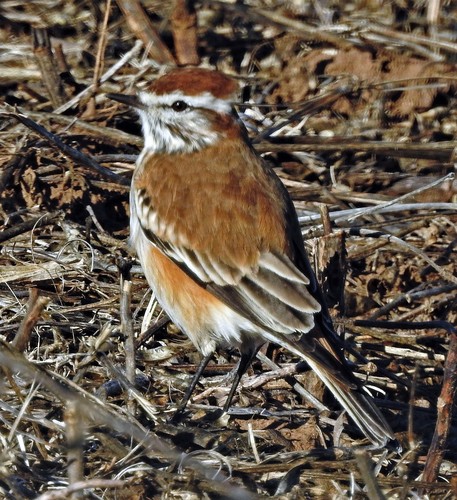
The rusty-backed monjita (scientific name Xolmis rubetra (Burmeister, 1860)) measures 18 to 19 cm (7.1 to 7.5 in) in length. Adult males have a rufescent crown and a long white supercilium on an otherwise white face marked with black streaks. Their upperparts are mostly rufescent or rufous-brown, with a grayish white rump. Their wings are mostly black; the greater and median coverts have grayish white edges and tips, the lesser coverts are rufescent, and the tertials have white edges. Their tail is mostly black, with white outer webs on the three outer pairs of feathers. Their throat and underparts are mostly white, with black streaks on the sides of the neck and across the breast, and a rufous tinge on the flanks. Adult females are duller and less rufescent than males. Both sexes have a dark iris, a black bill, and black legs and feet. Immatures have dull buffy upperparts, and a buffish throat and breast. The rusty-backed monjita is found in Argentina, in an area roughly bounded by the provinces of Tucumán, Entre Ríos, and northeastern Santa Cruz. It has also been recorded as a vagrant in extreme southern Brazil and in Chile. This species inhabits grasslands and steppe with scattered small bushes, and it is sometimes found along the shores of lakes. It occurs at elevations up to 1,000 m (3,300 ft).