About Xolmis cinereus (Vieillot, 1816)
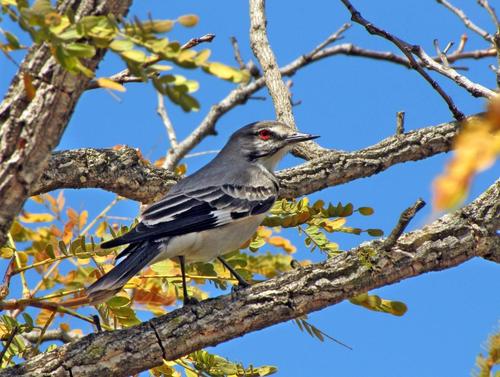
The grey monjita (Xolmis cinereus) is 21 to 25 cm (8.3 to 9.8 in) long and weighs 50 to 62 g (1.8 to 2.2 oz). Both sexes share the same plumage, and the two recognized subspecies are essentially identical in appearance. Adult individuals have a mouse-gray or dusky grayish crown, a broad white stripe running from the lores to above the eye, and a thin white "moustache" mark with a wider black stripe positioned below it. Their upperparts are mouse-gray or dusky grayish. Their wings are black with broad white bases on the primary feathers that are visible when the bird is in flight. The wing coverts have white tips, and the tertials have white edges. Their tail is black, with broad white tips on each tail feather. Their throat is white, their breast is ashy gray, and their belly is white. Juvenile grey monjitas have a brown tinge mixed into their gray base plumage. Adult grey monjitas have a bright red iris, a black bill, and black legs and feet. The nominate subspecies of the grey monjita has a small, isolated population located in the Sipaliwini Savanna of southern Suriname. Its main range extends from Amapá in northeastern Brazil south through eastern Brazil to Rio Grande do Sul, and continues beyond that through Uruguay and into Misiones Province in northeastern Argentina. Subspecies X. c. pepoaza is found from Pampas del Heath in extreme southeastern Peru's Madre de Dios Department, extending east and south through northern and eastern Bolivia, southern Mato Grosso do Sul in west-central Brazil, and Paraguay, reaching as far south into Argentina as Tucumán and northern Buenos Aires provinces. This species inhabits grassland and cerrado habitats, and it can sometimes be found near human structures and settlements. During migration, it is often spotted within cities. In terms of elevation, its distribution ranges from sea level up to approximately 1,200 m (3,900 ft).