About Xiphorhynchus lachrymosus (Lawrence, 1862)
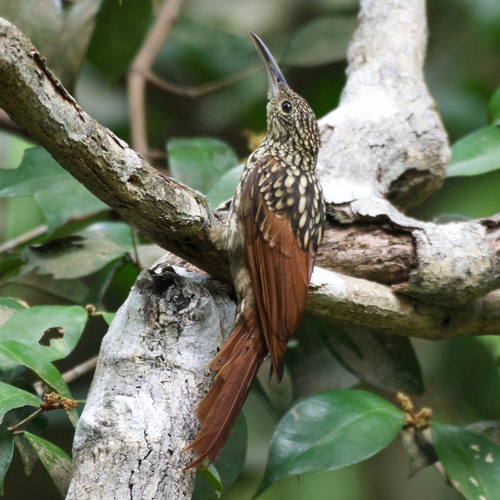
The black-striped woodcreeper (Xiphorhynchus lachrymosus) measures 21.5 to 25 cm (8.5 to 9.8 in) in length and weighs 51 to 66 g (1.8 to 2.3 oz). It is a medium-sized member of the genus Xiphorhynchus, with a moderately long, nearly straight bill that has a slight downward droop at the tip. The sexes have identical plumage. Adults of the nominate subspecies have a brownish black face marked with buff streaks and lack a distinct supercilium. Their crown and nape are brownish black with buffy teardrop-shaped spots and wide streaks. Their back and scapulars are also brownish black, with wider streaks of deeper buff. Their lower back, rump, and wings are dark cinnamon-rufous; the outer primaries have dusky tips. Their inner wing coverts are also dark cinnamon-rufous, while the outer coverts are brownish black with paler streaks. Their tail is rufous-chestnut. Their throat is pale to deep buff, with a thin black lower edge. Their breast and belly are pale buff: the breast has a scaly appearance, and the belly has streaks. Their sides and flanks are grayish brown with faint streaks, their undertail coverts are brownish with pale buff streaks, and their underwing coverts are deep ochraceous buff to tawny buff. Their iris ranges from dark reddish brown to dark brown, their maxilla is dark brown to black, their mandible is silver-gray to bluish white, and their legs and feet are green to bluish gray or dark gray. Juveniles are similar to adults but have a more muted pattern: the black edges of their feathers are browner, their throat has heavier scaling, their underparts are whiter, and their bill is shorter. Subspecies X. l. eximius has more distinct black streaking on the breast than the nominate, and this streaking extends through the belly. Its upper back has more blackish coloring within the streaks, and its wings and tail are a deeper rufous. Subspecies X. l. alarum has smaller buffy spots on the back than the nominate, with narrow black edges and wider dark brown edges. Its greater wing coverts have brown rather than black inner webs, and the spots on its underparts are smaller. The combination of size and the pattern of pale buff and black streaks makes the black-striped woodcreeper unique among all woodcreepers. The nominate subspecies of black-striped woodcreeper occurs on the Caribbean slope from eastern Nicaragua, through Costa Rica and Panama, and also on the Pacific slope from the Canal Zone, through western Colombia, into Ecuador as far south as Pichincha Province. Subspecies X. l. eximius is found on the Pacific slope of southwestern Costa Rica and western Panama. Subspecies X. l. alarum is found in Colombia, ranging from the Sinú, Cauca, and Magdalena river valleys eastward into Santander Department. The black-striped woodcreeper mostly lives in humid lowland forest. It prefers evergreen forest, but also extends into mangroves in some regions. It also favors the interior of tall mature forest, but is regularly found at forest edges and gaps, in older secondary forest, and occasionally in tree plantations. In terms of elevation, it mostly occurs between sea level and 1,000 m (3,300 ft), but reaches as high as 1,200 m (3,900 ft) in Costa Rica and 1,500 m (4,900 ft) in Colombia.