About Xiphorhynchus guttatus (Lichtenstein, 1820)
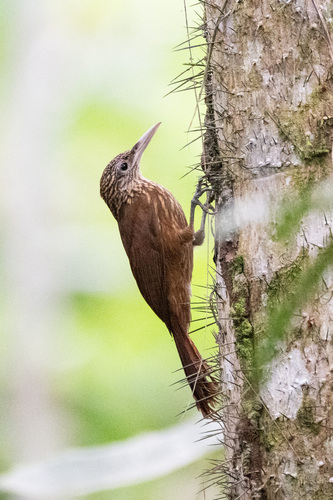
The buff-throated woodcreeper (Xiphorhynchus guttatus, first described by Lichtenstein in 1820) measures 22.5 to 29.5 cm (8.9 to 12 in) in length and weighs 45 to 74 g (1.6 to 2.6 oz). It is the largest species in the genus Xiphorhynchus, with a heavy build and a long, heavy, decurved bill. The two sexes have identical plumage. For the nominate subspecies X. g. guttatus, adults have a dark brown face marked with narrow whitish-buff streaks. Their crown and nape are dark brown, with buff teardrop-shaped spots; the spots become streakier and have blackish edges on the nape. Their back and wing coverts are reddish olive-brown, with buff streaks that have blackish edges on the back. Their lower back and rump are cinnamon-rufous, their flight feathers are a darker rufous with dusky brownish tips on the primaries, and their tail is rufous-chestnut. Their throat is deep buff with a dusky lower edge. Their breast, sides, and belly are reddish brown that becomes redder on the undertail coverts. Their breast and sides have black-edged deep buff streaks that narrow on the belly, and their undertail coverts are mostly unstreaked. Their underwing coverts range from cinnamon-rufous to ochraceous buff. Their iris is dark brown, their bill is dark brownish black with a paler culmen and an even paler mandible, and their legs and feet can be blue, greenish gray, or dark gray. Juveniles have a shorter, blacker bill than adults, a more rufous belly, and wider streaks with blacker edges on both their upper and underparts. Other subspecies differ from the nominate as follows: X. g. polystictus has a much darker crown than back, and its back has wide buff streaks with wide black edges. X. g. connectens is similar to polystictus, but has deeper buff underparts and heavier, deeper buff streaking on the crown, nape, and underparts. X. g. guttatoides has a pale horn-colored bill, is overall more rufescent, has a darker crown than back, a richer buff throat, and richer buff streaking with weaker dark edges on both upper and underparts. X. g. dorbignyanus has a paler bill than guttatoides, is paler and more olive overall than the nominate, has nearly matching crown and back color, and has narrow streaks with little to no dark edges on both upper and underparts. X. g. eytoni has a slimmer, mostly blackish bill, more olive upperparts, a richer rufous rump, grayer underparts, a whiter throat, and whiter streaking with sharp black margins on both upper and underparts. X. g. vicinalis has a blackish bill, whitish throat, strongly rufescent underparts, and buffier, heavier streaks than eytoni. X. g. gracilirostris is similar to eytoni, but has a longer, slimmer, and more decurved bill. The subspecies of the buff-throated woodcreeper are distributed as follows: X. g. polystictus is found in the Rio Orinoco drainage of eastern Colombia, southern and eastern Venezuela, and extreme northern Brazil, ranging east to the Guyanas. X. g. connectens is found north of the Amazon River from roughly Manaus east to Amapá. X. g. guttatus is found in coastal eastern Brazil from Rio Grande do Norte south to Espírito Santo, extending slightly into Rio de Janeiro state. X. g. guttatoides is found in the western Amazon Basin on both sides of the Amazon, ranging from southern Venezuela, southeastern Colombia, eastern Ecuador, eastern and southeastern Peru, and northwestern Brazil east to the Rio Negro and Rio Madeira, and south into Mato Grosso. X. g. dorbignyanus is found in the southern Amazon Basin from northern and eastern Bolivia east into Brazil as far as central Goiás. X. g. eytoni is found in Brazil south of the Amazon from Rio Tapajós east to western Maranhão. X. g. vicinalis is found in Brazil south of the Amazon from Rio Madeira east to Rio Tapajós. X. g. gracilirostris is restricted to Serra do Baturité in Ceará state, northeastern Brazil. The buff-throated woodcreeper generally inhabits humid evergreen forest, with habitat details varying across its very large range. Within the "buff-throated" group, the nominate X. g. guttatus is only found in humid tropical Atlantic forest. The other two subspecies in this group live in semi-deciduous forest, gallery forest, palm swamps, treed areas of savanna, cerrado woodlands, and mangroves. The subspecies of the "Lafresnaye's" group, like the northern "buff-throated" subspecies, occur in semi-deciduous and gallery forest, palm swamps, treed areas of savanna, and cerrado woodlands. Populations in the Amazon Basin inhabit terra firme, floodplain forest, and both várzea and igapó types of seasonally flooded forest. Members of the "dusky-billed" group favor terra firme, while other Amazonian subspecies favor the other three forest types and also occur in evergreen montane forest along the Andes. All subspecies prefer forest edges, internal forest gaps, and older secondary forest, though they are also regularly found in the interior of primary forest. Most individuals occur between sea level and 800 m (2,600 ft) in elevation. X. g. polystictus has been recorded as high as 1,200 m (3,900 ft) in Colombia and 1,250 m (4,100 ft) in the tepui region where Venezuela, Guyana, and Brazil meet. X. g. dorbignyanus reaches 1,100 m (3,600 ft) in Bolivia.