About Xiphorhynchus fuscus (Vieillot, 1818)
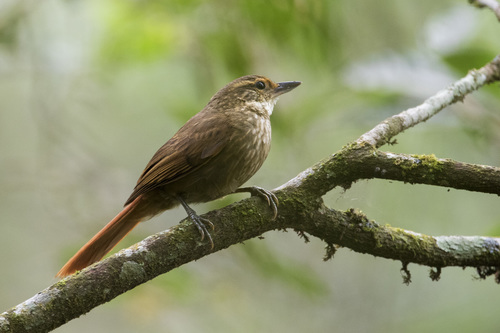
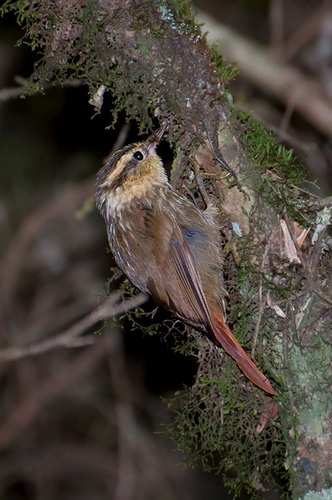
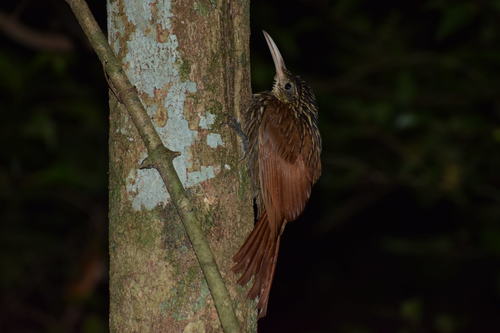
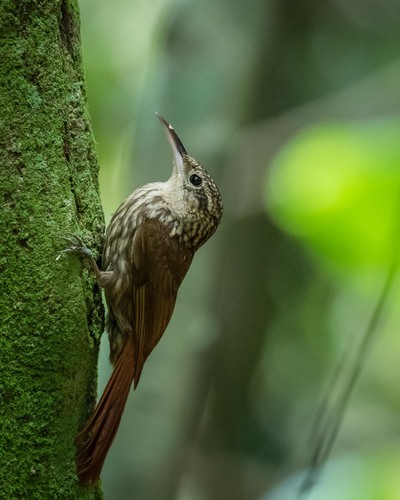
This species, commonly called the striped woodcreeper or lesser woodcreeper, is a small, slim member of the Xiphorhynchus genus, with a relatively long, slim, slightly curved downward-pointing bill. The species measures 15 to 18.5 cm (5.9 to 7.3 in) in length and weighs 15.5 to 25 g (0.55 to 0.88 oz). Sexes of this species have identical plumage. Adults of the nominate subspecies have a mostly dusky face with a broad creamy to yellowish buff supercilium, and often a pale eyering. Their crown and nape are blackish brown; the crown has small yellowish buff to cinnamon spots, which become streaks on the nape and sides of the neck, and extend weakly onto the upper back. Their back and wing coverts are olive-brown to reddish brown. Their flight feathers, rump, and tail are rufous-chestnut, with darker outer webs and tips on the flight feathers. Their throat is solid creamy yellow. Their breast and belly are smoky brown, with a bold scaly pattern created by dark-edged buff spots. Their undertail and underwing coverts are cinnamon. Their iris is dark brown; their maxilla is blackish brown to dark horn, often with a darker base; their mandible is pinkish to white, sometimes with a darker tip; and their legs and feet are olive-gray to bluish gray. Juveniles have weaker spotting on their underparts, but are otherwise identical to adults. Subspecies X. f. tenuirostris is larger than the nominate subspecies, and the spots on its underparts are paler with brown edges. Subspecies X. f. pintoi is paler overall than the nominate subspecies, more yellowish on its underparts, and has more cinnamon coloration on its wings and tail. The nominate subspecies is the most widespread of the three. It occurs from Goiás, Minas Gerais, and Espírito Santo in southeastern Brazil, south into southern and southeastern Paraguay and Argentina's Misiones Province. X. f. tenuirostris occurs in coastal eastern Brazil, from central Bahia south into Espírito Santo. X. f. pintoi occurs in western Bahia. The lesser woodcreeper lives in a range of forested habitats. Across most of its range, it is found in lowland rainforest and humid montane forest. In inland areas, it occurs in drier semi-deciduous and gallery forests, and in the southern part of its range, it occurs in forest dominated by Araucaria. It prefers the interior and edges of primary forest and mature secondary forest, and is occasionally found in younger growth and more open landscapes adjacent to forest. It mostly occurs at elevations below 1,200 m (3,900 ft), but can be found as high as 1,500 m (4,900 ft), and possibly higher still.