About Xiphorhynchus flavigaster Swainson, 1827
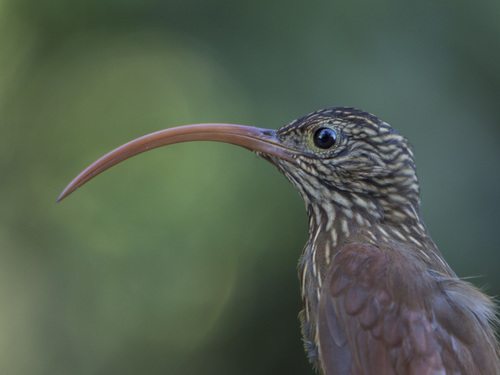
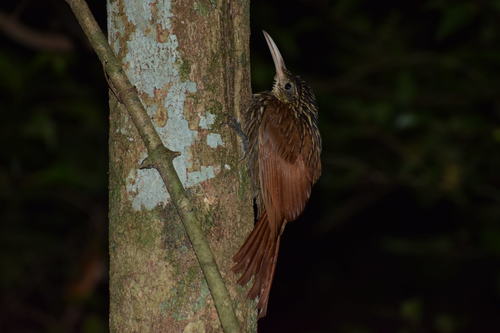
The ivory-billed woodcreeper (Xiphorhynchus flavigaster Swainson, 1827) measures 20 to 26.5 cm (7.9 to 10 in) in total length. Males weigh 40 to 62 g (1.4 to 2.2 oz), while females weigh 35 to 56 g (1.2 to 2.0 oz). It is a medium-sized member of the genus Xiphorhynchus, with a long, fairly heavy, slightly decurved bill. The sexes share identical plumage. For adults of the nominate subspecies X. f. flavigaster, the face has fine buffy and blackish streaks, an indistinct buffy supercilium and eyering, and a faint dark stripe behind the eye. The crown and nape are dark grayish brown, with longish buff spots that are almost streaks. The back and wing coverts are light grayish brown to olive-brown, marked with blackish-edged buff streaks. The rump, tail, and wings are chestnut. Flight feathers are paler than the tail, with dusky tips on the outer primaries. The throat is buffy with thin dusky streaks. The upper breast is lighter than the throat and has a scaly appearance. The rest of the underparts are light buffy brown, with dusky-edged buffy streaks that become less distinct toward the belly. Underwing coverts are ochraceous buff. The iris ranges from light reddish brown to dark brown, the bill is pale with a brownish or bluish base on the maxilla, and the legs and feet can be yellowish green, olive-gray, or brownish. Juveniles are slightly darker overall than adults, with bolder streaks on the throat, duller streaks on the back and breast, and a brownish bill. Other subspecies differ from the nominate and from each other as follows: X. f. tardus is much smaller, paler, and grayer than the nominate. X. f. mentalis is smaller than the nominate, with a shorter bill. X. f. saltuarius is darker and browner than the nominate, but paler than X. f. eburneirostris especially on the belly; it also has larger, bolder streaks on the upperparts, and less well defined streaks on the underparts. X. f. yucatanensis is smaller than X. f. mentalis, with a pale buff unmarked throat. X. f. ascensor is the darkest of all subspecies overall, with richer brown color on the upperparts, a streaked (not spotted) crown, deep chestnut wings and tail, all streaks are wider with wider black edges, and streaks extend onto the belly. X. f. eburneirostris is darker and browner than the nominate, with sooty black crown and nape, richer buff streaks on the upper and underparts, and the throat only has fine streaks along its edge. X. f. ultimus is larger and darker than X. f. eburneirostris, with richer buff underparts, blacker edges on underparts streaks, and a longer and heavier bill. All subspecies show a great deal of individual variation, which leads to weak differentiation between some groups. Most adjacent subspecies have intergrades. The subspecies of the ivory-billed woodcreeper have the following distributions: X. f. tardus is found in the northwestern Mexican states of Sonora, Sinaloa, and Durango. X. f. mentalis occurs on the Pacific side of Mexico from Sinaloa and Durango south into Guerrero. X. f. flavigaster is found in Guerrero and Oaxaca in southwestern Mexico. X. f. saltuarius occurs in northeastern Mexico from Tamaulipas and San Luis Potosí south into Veracruz. X. f. yucatanensis ranges across the Yucatán Peninsula and south into Belize and Guatemala. X. f. ascensor occurs on the Caribbean side of southern Mexico from Veracruz and Oaxaca to Tabasco, and possibly extends into Guatemala. X. f. eburneirostris is found on the Caribbean slope from central Guatemala and Belize through Honduras slightly into Costa Rica, and on the Pacific slope from Oaxaca and Chiapas in Mexico through Guatemala, El Salvador, and Honduras into northwestern Costa Rica. X. f. ultimus is restricted to Costa Rica's Nicoya Peninsula. The ivory-billed woodcreeper lives in a wide variety of forested landscapes. It favors deciduous woodland, and also occurs in semi-deciduous forest, evergreen forest, gallery forest, pine-oak forest, pine forest, thorn scrub, freshwater swamps, and mangroves. It can be found in the interior and edges of both primary and secondary forest, and also inhabits plantations. It tends to occupy drier landscapes than many other species of woodcreeper. In terms of elevation, it mostly occurs from sea level to about 1,500 m (4,900 ft), but locally ranges as high as 2,900 m (9,500 ft).