About Xiphocolaptes promeropirhynchus (Lesson, 1840)
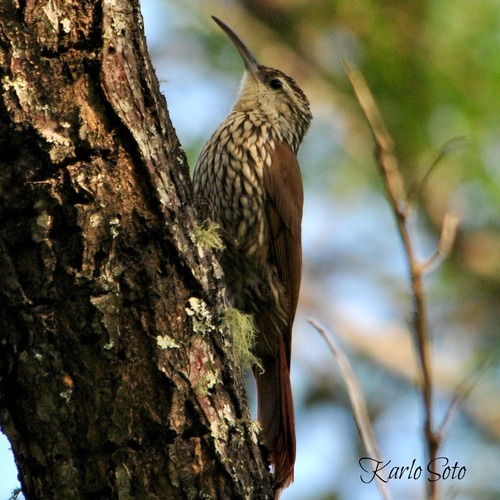
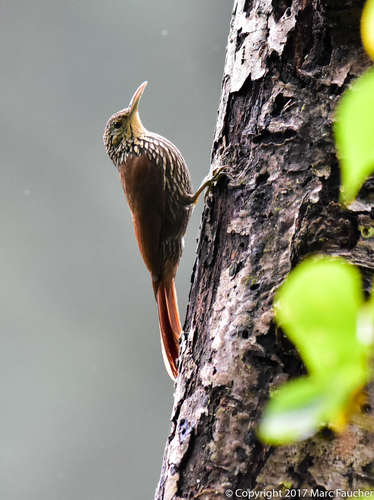
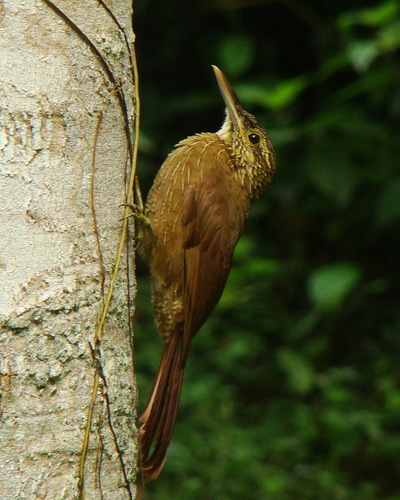
Xiphocolaptes promeropirhynchus, commonly called the strong-billed woodcreeper, is one of the largest members of the ovenbird family, and is the heaviest woodcreeper. However, the slender long-billed woodcreeper (Nasica longirostris) is longer in body length, and the great rufous woodcreeper (Xiphocolaptes major) is larger overall. The strong-billed woodcreeper measures 28 to 31.5 cm (11 to 12 in) in length, and weighs between 103 and 144 g (3.6 and 5.1 oz). Males and females have identical plumage. Adults of the nominate subspecies X. p. promeropirhynchus have a dark brown crown and nape marked with buff streaks. Most of the face is dusky, with buffy coloring on the lores, supercilium, 'moustache', and throat stripe. The back, scapulars, and wing coverts are brown, with faint buff streaks on the shoulder. The lower back is russet, which darkens to rufous chestnut on the rump. The tail is dark chestnut with paler feather shafts. Flight feathers are tawny brown with dusky tips and rufous chestnut inner webs. The throat is plain buffy. The breast and flanks are brownish, while the belly and undertail coverts are tawny cinnamon with small dark spots or bars. Narrow buffy streaks mark the breast and belly. The bill is long, stout, and somewhat decurved, and its color ranges from gray to black. The iris is dark brown, amber, or red, and the legs and feet are bluish gray, green, or grayish black. Juveniles have a deeper overall body color than adults, with ochre tips on the wing coverts and paler streaks on the crown and breast. Other subspecies of the strong-billed woodcreeper differ from the nominate in various ways not detailed here. Different subspecies of the strong-billed woodcreeper are distributed across different regions. This species inhabits a very wide variety of temperate, subtropical, and tropical forested landscapes. It favors the interior of primary forest, and also occurs at forest edges, in semi-open forest, and in mature secondary forest. It mostly avoids fragmented forests, plantations, and young secondary forest. Subspecies found in Middle America occur in montane forest, principally oak and pine-oak associations, but also live in lowland rainforest and pine-dominated ridges. Subspecies of the Amazon Basin inhabit humid forest, principally terra firme and várzea, and only rarely occupy gallery and permanently flooded forest. The remaining subspecies, found in the northern and central Andes, the coast ranges, and the tepuis, inhabit humid evergreen forest, cloudforest, and also drier forest. Across the entire species, elevation ranges from sea level to 3,500 m (11,500 ft). In Mexico, it occurs between 1,500 and 3,500 m (4,900 and 11,500 ft). In northern Central America, it mostly ranges from 1,200 to 2,850 m (3,900 to 9,400 ft) but also occurs in lowlands. In southern Central America, it occurs between 500 and 1,700 m (1,600 and 5,600 ft). In Colombia, it can be found as low as 100 m (330 ft) but mostly occurs above 1,500 m (4,900 ft). In Venezuela, it ranges from near sea level to 2,800 m (9,200 ft) but mostly occurs above 400 m (1,300 ft). In eastern Ecuador it occurs up to 600 m (2,000 ft), and in the Andes of Ecuador it ranges between 1,000 and 3,000 m (3,300 and 9,800 ft). In Peru it occurs up to 2,850 m (9,400 ft), and it is only found in lowlands in Guyana and Brazil.