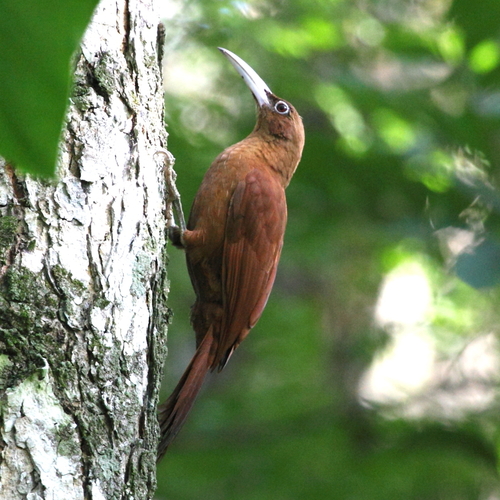
About Xiphocolaptes major (Vieillot, 1818)
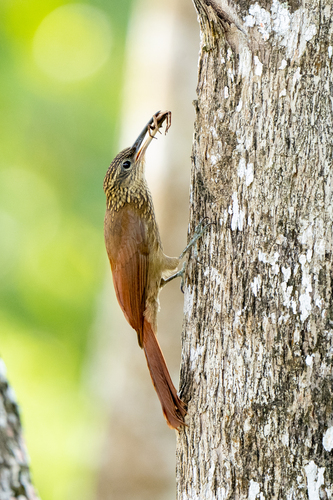
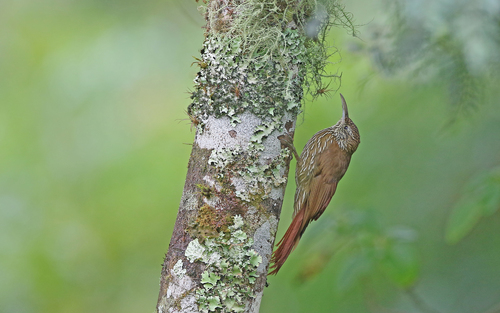
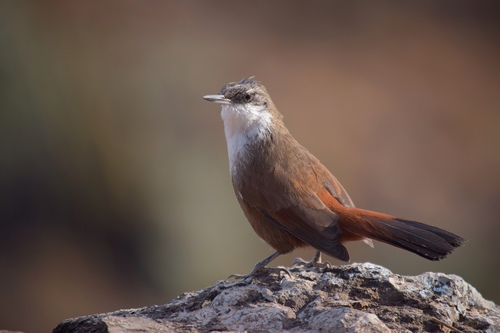
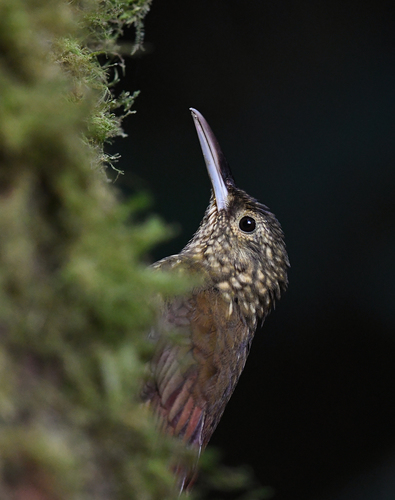
Xiphocolaptes major, commonly called the great rufous woodcreeper, is the largest (though not the heaviest) member of its subfamily. It has a heavy body, and a long, heavy, somewhat downward-curved bill. The species measures 27 to 34 cm (11 to 13 in) in total length. Males weigh 120 to 150 g (4.2 to 5.3 oz), while females weigh 120 to 162 g (4.2 to 5.7 oz). Males and females have identical plumage. Adults of the nominate subspecies X. m. major are almost entirely bright rufous-cinnamon. Their crown is slightly darker than the rest of their body, their tail is a richer chestnut color, and their flight feathers are reddish brown with dusky tips on the primaries. They have blackish lores, a pale cinnamon throat marked with whitish buff streaks, and cinnamon underparts with some buffy streaks on the breast and dusky brownish bars on the belly. Their iris can be dark brown, rich red-brown, or crimson. Their bill is pale, ranging from horn colored to horn-white, and their legs and feet are dark grayish olive, greenish, or bluish gray. Juveniles are generally brighter in overall color than adults, especially on their underparts; they have stronger streaking on the breast but weaker streaking on the crown. The four recognized subspecies differ in coloration and patterning: X. m. remoratus has darker upperparts than the nominate, with less reddish underparts that have more extensive streaking and barring. X. m. castaneus is darker overall than the nominate, with a more brownish head, deeper chestnut upperparts, and less streaking and barring on the underparts. X. m. estebani is much lighter overall than the nominate, but is otherwise similar in appearance. The subspecies of great rufous woodcreeper have separate geographic ranges: X. m. remoratus is found in southwestern Mato Grosso state, Brazil. X. m. castaneus occurs in north-central and eastern Bolivia, southern Brazil's Mato Grosso do Sul state, and the Jujuy and Salta provinces of northwestern Argentina. X. m. estebani is restricted to Tucumán Province in northwestern Argentina. The nominate subspecies X. m. major inhabits western Paraguay and northern Argentina, ranging south as far as Córdoba and Santa Fe provinces. The great rufous woodcreeper lives in a variety of forested landscapes, including dry woodland, semi-deciduous woodland, gallery forest, and Gran Chaco woodland. It also occurs in scrubby forest, cerrado, and wooded savanna. It prefers the interior of forest, but is occasionally found at forest edges. Most of its range occurs below 1,500 m (4,900 ft) in elevation, though it can be found as high as 1,800 m (5,900 ft).