About Xiphocolaptes albicollis (Vieillot, 1818)
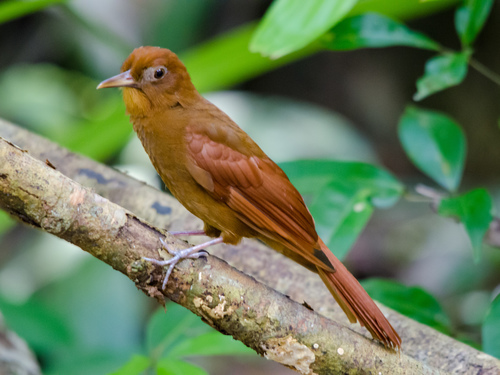
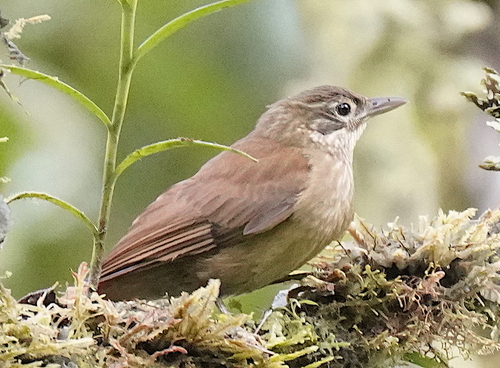
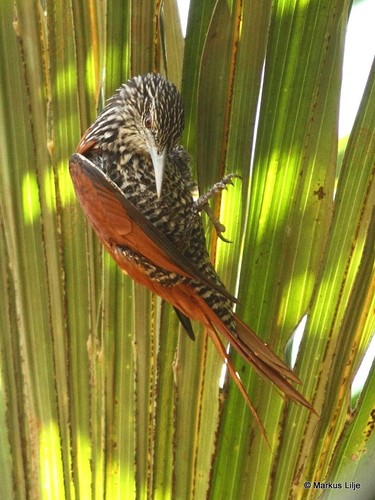
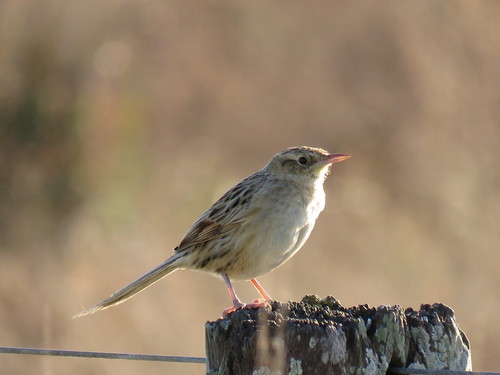
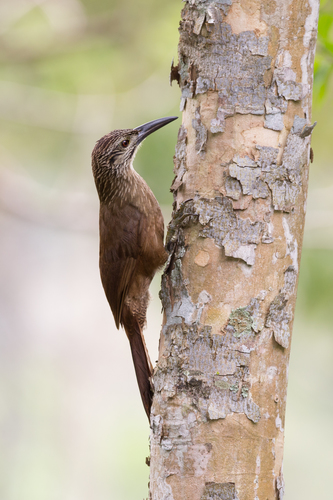
Xiphocolaptes albicollis, commonly called the white-throated woodcreeper, is one of the largest species in its subfamily. It has a heavy body, a moderately short tail, and a long downward-curved bill. Adults measure 27.5 to 33 cm (11 to 13 in) in length and weigh 110 to 130 g (3.9 to 4.6 oz). Males and females have identical plumage. For the nominate subspecies, adults have a dark face with a whitish to pale buff supercilium and moustachial stripe, a dark stripe behind the eye, and a blackish stripe on the cheek. Their forehead, crown, and nape are black, with bold cream to buff streaks across the crown. Their back and wing coverts are brownish olive, and their rump is rusty chestnut, with faint light streaks on the upper back. Their flight feathers have light chestnut inner webs, dark brown outer webs, and dusky tips. Their tail is dark chestnut, with darker shafts on each feather. Their throat is white to buffy white, and their underparts range from olive-brown to tawny. Their breast and sides have bold pale buff to whitish streaks that have dark edges, and their belly, thighs, and undertail coverts have distinct darker bars. Their iris is red to brown, their bill is black (sometimes with a horn-colored lower mandible), and their legs and feet vary widely in color but are generally dark. Juveniles resemble adults, but have a shorter bill and rusty-yellow spots on the crown. The subspecies X. a. villanovae is overall paler than the nominate subspecies. It has a dark brown crown, a more prominent supercilium, weaker barring on the belly, and a shorter bill. The subspecies X. a. bahiae is also paler than the nominate, but with a browner overall tone. It has a dark brown crown with tawny-rufous streaks, its breast streaks lack dark edges, and it has a few dusky spots on its belly instead of barring. The nominate subspecies of white-throated woodcreeper ranges across southeastern and southern Brazil, from southern Bahia south to Rio Grande do Sul, through eastern Paraguay, and into Argentina as far as northeastern Corrientes Province. Subspecies X. a. villanovae occurs only in a small area around Senhor do Bonfim in northeastern Bahia, Brazil. Subspecies X. a. bahiae occupies a slightly larger range in the Chapada Diamantina of eastern and central Bahia, Brazil. This species is primarily found in the humid Atlantic Forest, but also lives in semi-deciduous forest and gallery forest within cerrado landscapes. It prefers the interior of undisturbed primary forest, but is regularly found at forest edges and in mature secondary forest. Most individuals occur below 1,500 m (4,900 ft) in elevation, though the species can be found as high as 2,000 m (6,600 ft).