About Xeromphalina cauticinalis (Fr.) Kühner & Maire
Xeromphalina cauticinalis is a species of agaric fungus belonging to the family Mycenaceae. Elias Fries first formally described it in 1838 under the name Marasmius cauticinalis, and Robert Kühner and René Maire reclassified it into the genus Xeromphalina in 1934.
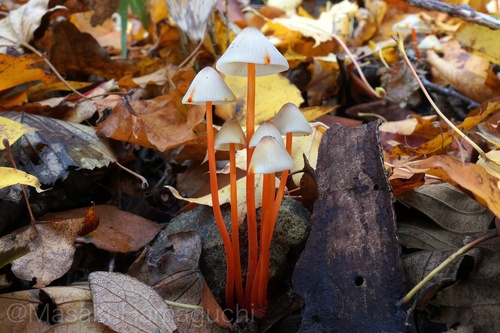
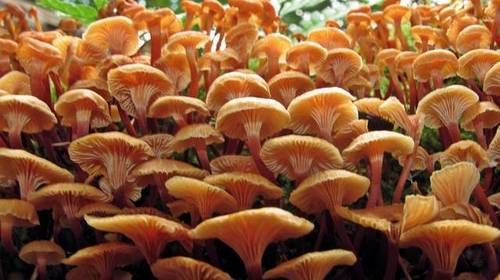
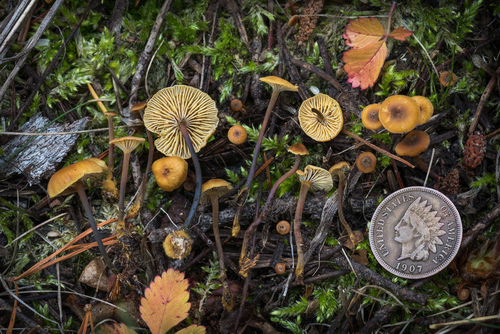
The fungal fruit bodies have convex, yellowish caps that range from 0.5 to 2.5 cm (1⁄4 to 1 inch) in diameter. Caps are supported by a tough yellow-brown to dark brown stipe (stem) that measures 2.5 to 8 cm (1 to 3+1⁄8 inches) long and 0.5 to 2.5 millimeters (1⁄32 to 3⁄32 inches) thick. The gills are pale yellow, spaced somewhat far apart, and attach to the stipe in a decurrent arrangement, running down the length of the stem. This fungus produces a white spore print; individual spores are elliptical, smooth, amyloid, and measure 4–7 by 2.5–3.5 micrometers.
Xeromphalina cauticinalis is found in North America. It fruits from summer through autumn, with fruiting occurring later in the year on the West Coast. It typically grows on conifer debris, and sometimes grows on aspen leaves. This species is classified as nonpoisonous.