About Xerocomus illudens (Peck) Singer
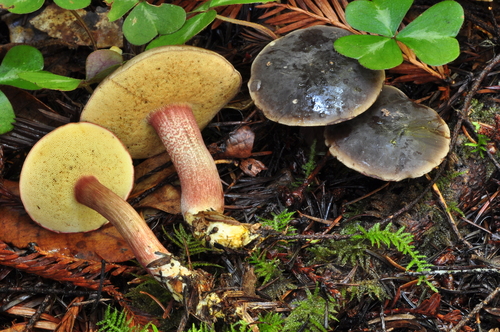
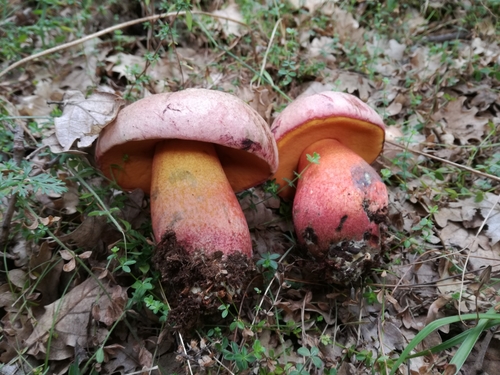
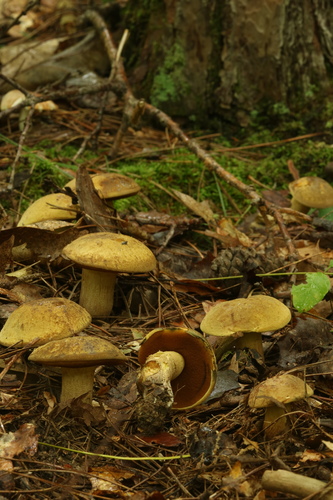
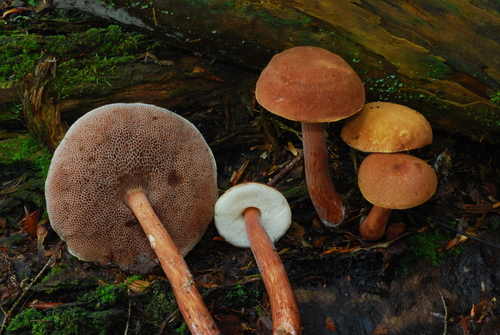
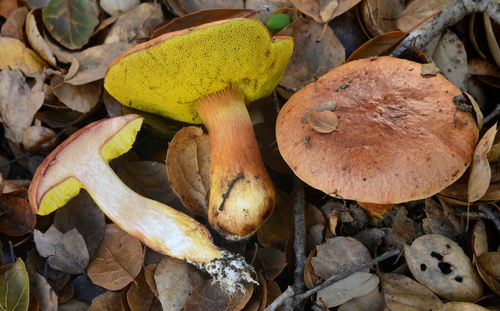
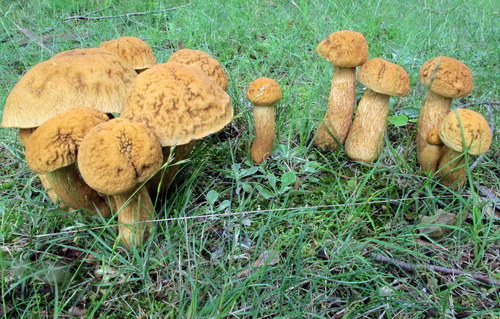
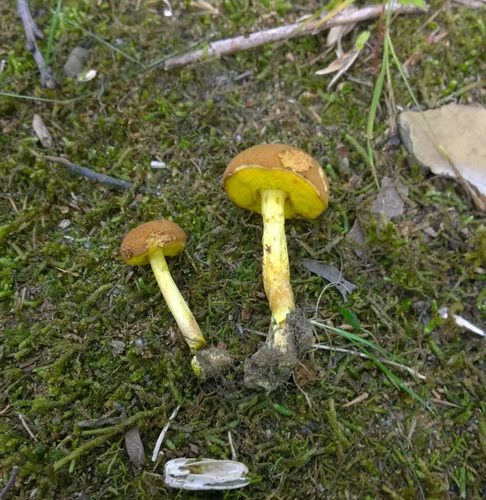
The fungus Xerocomus illudens has a cap that starts convex and becomes flattened when mature, reaching 3–9 cm (1.2–3.5 in) in diameter. The cap surface is dry, with a texture ranging from velvety to slightly hairy. Young specimens have a pale brownish-yellow cap that gradually changes to yellow-brown or pinkish as it matures. Its flesh is pale yellow, with no distinct taste or odor, and unlike many bolete species, it does not turn blue when cut or injured. The pore surface on the underside of the cap is lemon yellow, with approximately 1–2 pores per millimeter, sometimes more in older individuals. The tubes that make up the hymenophore are 0.8–1.6 cm (0.3–0.6 in) deep. The stem is 3–9 cm (1.2–3.5 in) long and 0.5–1.3 cm (0.2–0.5 in) thick, tapering slightly toward the base. It is solid, not hollow, dry, yellow, and marked with longitudinal grooves that form a partial network-like reticulum on the surface. Xerocomus illudens produces an olive to olive-brown spore print. Its spores are elliptical to spindle-shaped, smooth, and measure 10–14 by 4–5 μm. The fruit bodies of this fungus are edible. They can be used for mushroom dyeing, and produce colors including beige with yellow, green, or gray tints, or light gold, depending on the mordant used. Xerocomus illudens is a mycorrhizal fungus that forms mutually beneficial associations with oak trees. Its fruit bodies grow singly, scattered, or in groups on the ground in oak or oak-pine forests. Fruiting occurs from July to October. In North America, its distribution ranges from eastern Canada south to South Carolina, and west to Alabama and Minnesota. It has also been recorded in India, in Ramna Forest of the Burdwan District, West Bengal, and in the Himalayas.