About Xerocomellus dryophilus (Thiers) N.Siegel, C.F.Schwarz & J.L.Frank
Xerocomellus dryophilus, commonly called the oak-loving bolete, was formerly known as Boletus dryophilus or Xerocomus dryophilus. It is a basidiomycete fungus belonging to the family Boletaceae. This species was moved to the genus Xerocomellus in 2014. Previously, its scientific epithet was used for a European species that is now formally described as Xerocomellus redeuilhii.
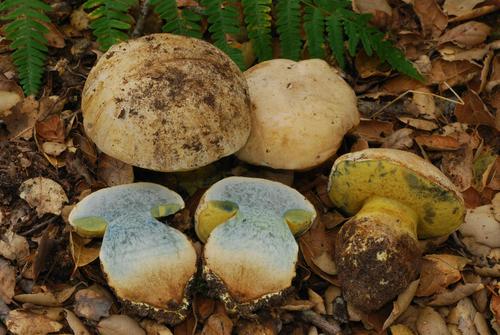
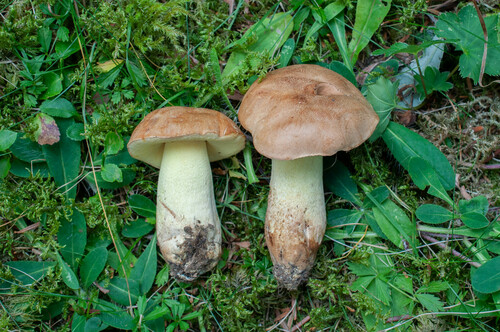
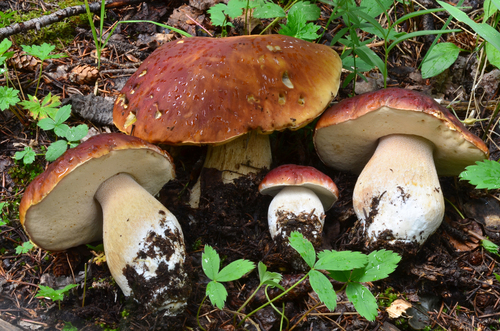
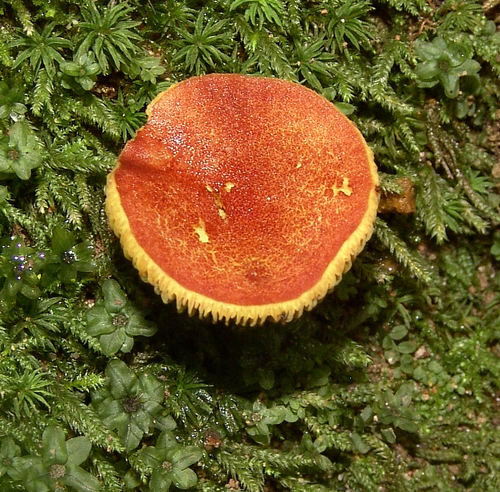
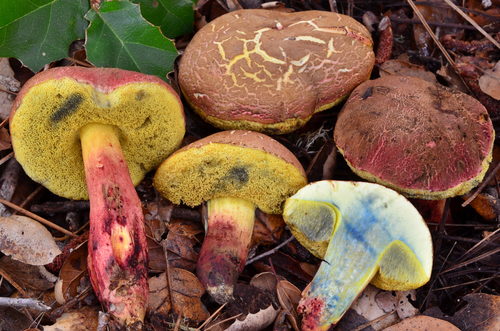
This fungus has a reddish cap that can grow up to 10 centimetres (4 inches) wide, with a shape that ranges from convex to flat. Its pores are yellowish, and both the pores and flesh often turn blue when bruised. It produces a brown spore print. The stem grows up to 12 cm long, is yellow at the apex and reddish in the lower portion. It is morphologically similar to X. chrysenteron and Boletus smithii.
Xerocomellus dryophilus has only been recorded growing under Quercus agrifolia (coast live oak), and is found exclusively in California, where it is one of the most common bolete species in Los Angeles and San Diego counties. It is frequently parasitized by the fungus Hypomyces chrysospermus. It is edible, though its quality is considered mediocre.