About Xerocomellus chrysenteron (Bull.) Šutara
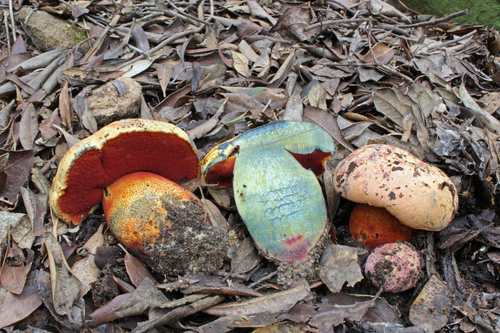
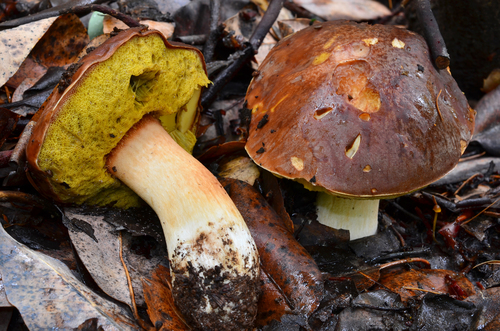
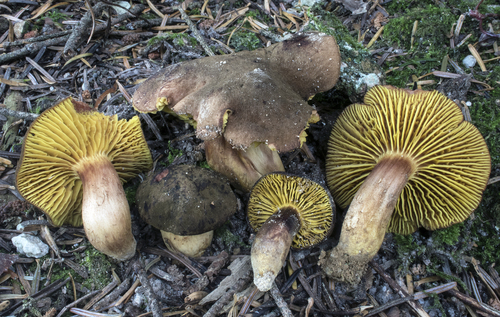
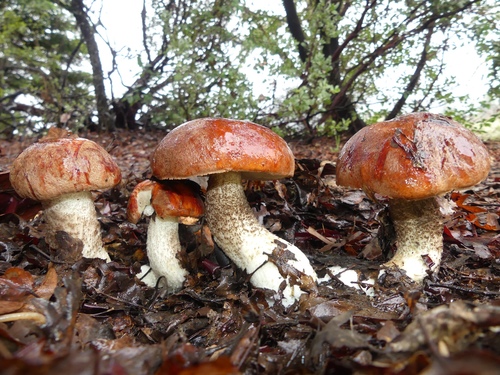
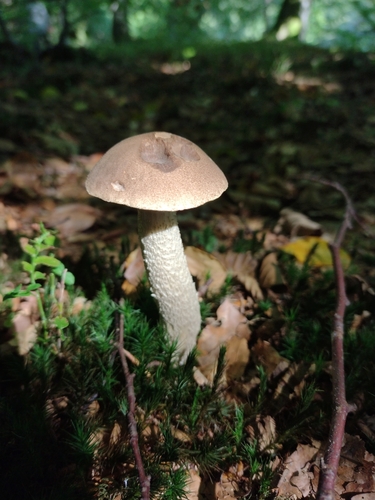
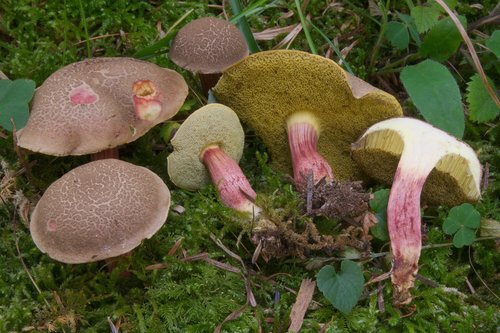
Xerocomellus chrysenteron (Bull.) Šutara has distinct physical characteristics across growth stages. Young specimens typically have dark, dry, tomentose caps. When fully expanded, the brownish cap measures 4 to 10 cm (1+1⁄2 to 4 in) in diameter, with very little bulk and thin flesh that turns blue when slightly cut or bruised. As caps age, they become convex then flatten out completely. Cracks that form on mature caps reveal a thin layer of light red flesh just under the cap skin. Stems grow 4 to 13 cm long, with a consistent elliptical to fusiform diameter along their length, and reach 1 to 2 cm in diameter. They have no ring, are mostly bright yellow, and their lower section is covered in coral-red fibrils. The cream-colored flesh inside the stem also turns blue when cut. This species has large, yellow, angular pores, and produces an olive brown spore print. Xerocomellus chrysenteron grows singly or in small groups in mixed hardwood and conifer woods from early summer to mid-winter. It forms mycorrhizal associations with hardwood trees, and is often found growing with beech on well-drained soils. It is common in parts of the northern temperate zones, and has been recorded in Taiwan. It has also been introduced to New Zealand, where it grows in groups under introduced deciduous trees. This species may be less common than previously thought, because it has often been misidentified as the recently recognized Boletus cisalpinus Simonini, Ladurner & Peintner. In ecological terms, the fruit bodies of X. chrysenteron are commonly infested by the bolete eater fungus Hypomyces chrysospermus.