About Xerochrysum bracteatum (Vent.) Tzvelev
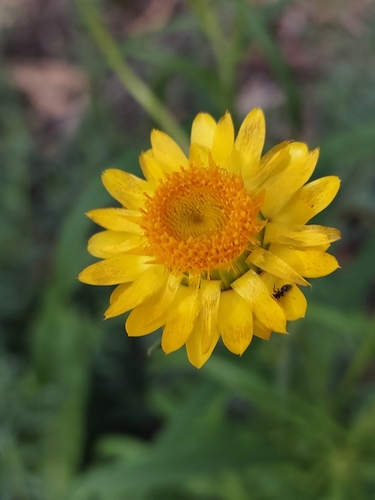
Xerochrysum bracteatum (Vent.) Tzvelev is an erect herb that is most often perennial, and occasionally annual. It is typically simple-branched or rarely branched at its base, usually growing 20 to 80 cm (8 to 31.5 in) tall, though it can develop a prostrate growth habit in exposed sites like coastal cliffs. Its green stems are rough, covered in fine hairs, and more robust than stems of other species in the Xerochrysum genus. Leaves are lanceolate, elliptic, or oblanceolate, measuring 1.5 to 10 cm (0.59 to 3.94 in) long and 0.5 to 2 cm (0.20 to 0.79 in) wide, and are covered in cobwebby hairs. Flower heads grow at the top of tall stems, above the foliage, and range from 3 to 7 cm (1 to 3 in) in diameter; occasionally, multiple flower heads develop from a single stem. Like all members of the Asteraceae family, these flower heads are structured with a central disc made up of many tiny individual flowers called florets, which grow directly on an enlarged stem section called the receptacle. Surrounding the disc is an involucre of modified leaves called bracts. In Xerochrysum, like most members of the tribe Gnaphalieae, these bracts are petal-like, stiff, and papery. Arranged in rows, the bracts curl over to enclose and shield the florets before the flower opens. They create the appearance of a shiny yellow corolla around the central disc. Intermediate bracts are sometimes white, while outer bracts are paler and often streaked reddish or brown; cultivated cultivars are available in a much wider range of colors. These bracts are papery, dry (or 'scarious'), and have very low water content. They are made of dead cells that have a thin primary cell wall and a thick secondary cell wall, a structure that is usually only found in structural sclerenchyma cells, not in flower or leaf cells. The individual florets are all yellow. Florets on the outer edge of the central disc are female, while florets at the centre are bisexual. Female florets do not have stamens, and only have a very short tube-shaped corolla surrounding a pistil that splits to form two stigmas. Bisexual (hermaphrodite) florets have a longer corolla, and like almost all Asteraceae species, they have five stamens fused at their anthers, with a pistil emerging from the centre. The yellow corolla and pistil sit above an ovary that holds a single ovule, and are surrounded by the pappus, Asteraceae's highly modified calyx. The pappus is made up of a number of bristles that radiate out around each floret. These yellow bristles persist on the mature fruit and are thought to help with wind dispersal of the 0.3 cm (0.12 in) long fruit. The fruit is a smooth brown cypsela that is 2 to 3 mm long, with the pappus radiating out from one end. In the wild, X. bracteatum can be told apart from similar species: from X. bicolor in Tasmania by its broader leaves and cobwebby stem hairs; from Western Australia's X. macranthum by flower head colour (X. macranthum has white flower heads, while X. bracteatum has golden yellow flower heads); from alpine and subalpine Xerochrysum subundulatum (found in New South Wales, Victoria, and Tasmania) by its non-rhizomatous growth and lack of markedly pointed orange bracts (X. subundulatum is rhizomatous); and from eastern Australian X. viscosum by its non-sticky leaves (X. viscosum has rough, sticky leaves). This species produces helenynolic acid, a rare fatty acid.
Xerochrysum bracteatum is native to Australia, where it occurs in all mainland Australian states and territories, as well as Tasmania. It is widespread across the continent, found from North Queensland across to Western Australia, and grows in all habitats except densely shaded areas. In Central Australia, it grows as an annual in patches of red sand, and responds quickly to periods of rainfall to complete its life cycle. It is common on granite outcrops in southwest Western Australia, and grows on heavier, more fertile soils (such as those derived from basalt, shale, or limestone) in the Sydney region, usually in areas with a high water table. In the Sydney Basin, it is associated with Eucalyptus pilularis (blackbutt) in open forest, and with shrubs Empodisma minus and Baloskion australe in swampy areas. It has also been recorded growing in disturbed soil, along roadsides, and in fields in the New England region of the United States.
The bright coloured bracts function like petals to attract pollinating insects, including hoverflies, native bees, and small beetles. Grasshoppers also visit the flower heads. Caterpillars of both Tebenna micalis and the Australian painted lady (Vanessa kershawi) have been recorded feeding on this species. The tiny fruits are dispersed by wind, and germinate and grow after fire or on disturbed ground. Flower production corresponds to longer day lengths, and plants generally produce the most flowers from December to March. Changing planting times or artificially adjusting light levels can allow increased flower production outside these months. Several pathogens and pests have been recorded affecting this species: The water mould (oomycete) Bremia lactucae has infected commercial crops in Italy and California. In 2002, widespread infection on the Ligurian coast affected multiple cultivars, most severely 'Florabella Pink', and to a lesser degree 'Florabella Gold' and 'Florabella White'; infection caused leaf blistering, chlorotic lesions on leaves, and white patches on leaf undersides, particularly in areas with poor ventilation. A 2006 downy mildew outbreak in cultivated X. bracteatum in San Mateo County, California also caused large chlorotic lesions on leaves. Between 1994 and 2001, a Phytoplasma infection (genetically identical to the aster yellows pathogen) damaged crops in the Czech Republic, causing poor growth, bronzing of foliage, and malformed flower heads. The root-knot nematode Meloidogyne incognita attacks the roots, forms galls, and can cause illness or death of the plant.
Xerochrysum bracteatum had been introduced to cultivation in England by 1791. German horticulturist Herren Ebritsch obtained plant material and developed the species at his nursery in Arnstadt near Erfurt, Germany. He bred and sold cultivars in a wide range of colours from bronze to white to purple, which spread across Europe in the 1850s. The bracts of these early cultivars tended to stay cupped around the flower head, rather than flattening out like native Australian forms, and these early cultivars were annual rather than perennial. Many were given individual cultivar names, but today they are generally sold as mixed seed for growing as annuals. It is thought that coloured forms of South African Helichrysum were added to breeding programs, leading to the very wide range of available colours. X. bracteatum became popular with European royalty and nobility from the early 19th century, but was not widely noticed in Australia until the 1860s, when it became more common in Australian gardens. Most cultivars brought into cultivation in Australia in the late 20th century are perennials; 'Dargan Hill Monarch' was the first of these, and many more have followed. These perennial cultivars are profusely flowering, and come in many colours including white, yellow, orange, bronze, pink, and red. Their commercial lifespan is generally around three years. Queensland-based company Aussie Winners breeds a range of compact plants in colours from orange to white called the Sundaze series; plants in this series usually have larger leaves, and the series won the Gran premio d'oro at the 2001 Euroflora exposition in Geneva for best new plant series of the previous three years. 'Florabella Gold', a cultivar from the Florabella series, won the award for best new vegetative pot plant in the 1999 Society of American Florists competition. The Wallaby cultivars are a range of taller forms with narrow leaves and white, yellow, or pink flowers. Other commercial cultivar groups include the Nullarbor series, and Queensland Federation daisies, including cultivars 'Wanetta Sunshine' and 'Golden Nuggets'. Xerochrysum bracteatum is easy to grow from both seeds and cuttings, though named cultivars will only grow true to type from cuttings. Plants benefit from pruning away old growth in winter to encourage new spring growth. Dead-heading (pruning off old flower heads) promotes production of more flowers. Fresh seeds germinate in 3 to 20 days and require no special treatment. Plants grow best in acidic, well-aerated soil with a pH of 5.5 to 6.3 and low phosphorus levels. They are sensitive to iron deficiency, which causes yellowing (chlorosis) of the youngest leaves while the leaf veins remain green. Xerochrysum bracteatum can be grown in large pots or window boxes, and works well as a pioneer garden plant until other plants become established. Lower-growing cultivars are suitable for hanging baskets and border plantings. The flowers attract butterflies to gardens. Dried flowers of this species are long-lasting (retaining quality for years), and are used in floral arrangements and for the cut flower trade. More robust, long-stemmed forms are used for commercial cut flowers. The main factor that limits the lifespan of dried flowers is stem wilting, so flowers are sometimes wired into arrangements. Immersing flowers in glycerol or polyethylene glycol also extends their lifespan.