About Xenops rutilans Temminck, 1821
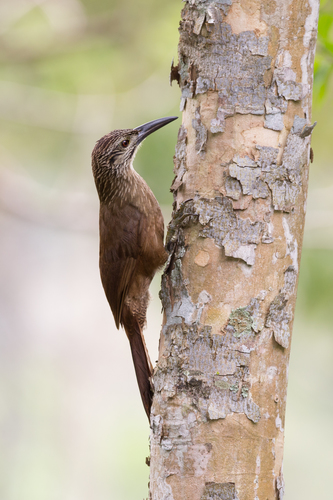
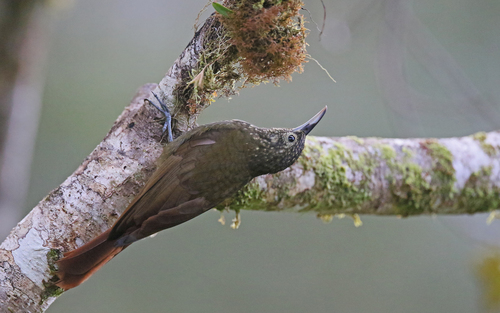
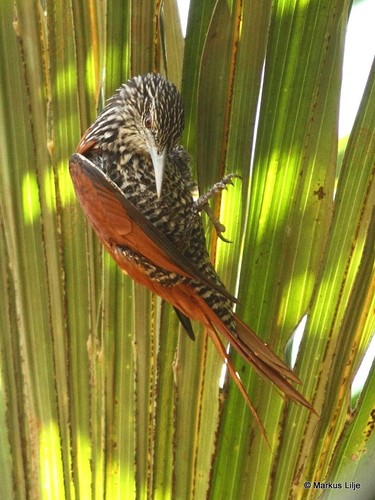
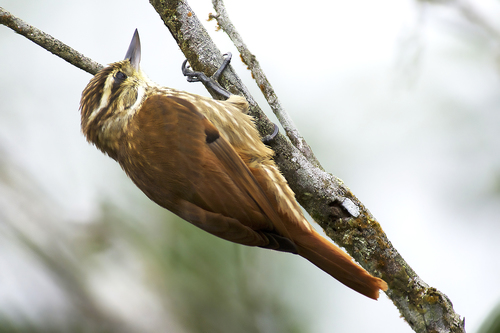
The streaked xenops (Xenops rutilans Temminck, 1821) is 12 to 13 cm (4.7 to 5.1 in) long and weighs 10 to 15 g (0.35 to 0.53 oz). It has a short, thick, wedge-shaped bill, and males and females have identical plumage. The nominate subspecies X. r. rutilans has somewhat variable plumage. Adults generally have a noticeable buff supercilium, a pure white malar stripe, and an otherwise brownish face with subtle darker and lighter markings. Their crown is dark brown with rufous streaks. Their back is rufescent brown with faint paler rufous streaks, their rump and uppertail coverts are solid chestnut-rufous, and their tail is chestnut-rufous with a blackish inner web on one pair of feathers. Their wing coverts are rufescent-brown with darker inner webs, and their flight feathers are dark fuscous; all but the inner pair of flight feathers have a rufous tinge on their outer webs. Their throat and upper breast are whitish with darker mottling. The rest of their underparts are medium brown, marked with broad buffy-white streaks that have dark brownish edges; these streaks grow narrower and less distinct toward the lower belly. Adults have brown to dark brown irises, a dark brown to blackish maxilla, a whitish to pinkish grey mandible with a blackish tip, and grey to black legs and feet. Juveniles differ from adults by having less distinct streaking, less black on the tail, and a cloudy greyish throat. The other 10 subspecies differ from the nominate to varying degrees, though much of the observed variation falls within the normal plumage variability of the nominate subspecies. Differences most often involve the intensity of rufous color on the upperparts, the size and exact color of underpart streaks, and the exact base color of the underparts. The species has 11 subspecies with the following distributions: X. r. septentrionalis is found in Costa Rica and western Panama's Chiriquí Province. X. r. incomptus occurs only on Cerro Pirre in extreme eastern Panama. X. r. heterurus is found in Trinidad, northern Venezuela east to the Paria Peninsula, and the Andes from Colombia south to Ecuador's Pastaza Province. X. r. perijanus occurs in Serranía del Perijá and the eastern Andes along the Colombia-Venezuela border. X. r. phelpsi is found in the Sierra Nevada de Santa Marta in northern Colombia. X. r. guayae inhabits lowlands from Esmeraldas Province in northern Ecuador south to Peru's Tumbes and Piura departments. X. r. peruvianus is found in Andean foothills from Morona-Santiago Province in eastern Ecuador south to Peru's Department of Puno. X. r. connectens occurs in eastern Andean foothills from La Paz Department in western Bolivia south to Tucumán Province in northwestern Argentina. X. r. purusianus ranges from extreme eastern Peru and northeastern Bolivia east through central Brazil to the Rio Tapajós. X. r. chapadensis is found in eastern Bolivia and southwestern Brazil. The nominate subspecies X. r. rutilans occurs in southeastern Brazil, north-central Paraguay, and northeastern Argentina. In the Andes and Central American mountains, the streaked xenops lives in montane evergreen and deciduous forests, mostly between 700 and 2,400 m (2,300 and 7,900 ft) in elevation. In Costa Rica it occurs from 1,200 to 2,500 m (3,900 to 8,200 ft), and in Colombia it occurs from 1,400 to 2,800 m (4,600 to 9,200 ft). In lowlands, it occupies a wide range of forest and woodland landscapes from semi-arid to humid, including tropical deciduous primary forest, tropical lowland evergreen primary forest, and secondary forest. It occurs both in the forest interior and along forest edges. In western Ecuador it reaches elevations of 2,000 m (6,600 ft), and in eastern Ecuador it ranges from 800 to 2,000 m (2,600 to 6,600 ft). Most of its range in Brazil is at low elevation, but the species can reach elevations as high as 2,400 m (7,900 ft) in the country.