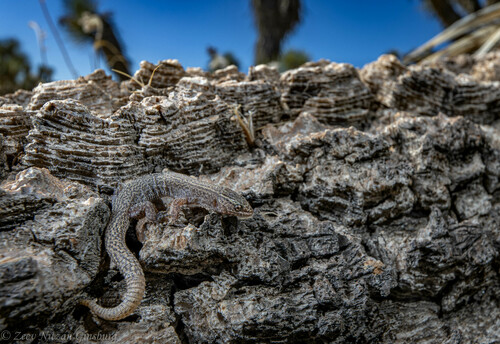
About Xantusia vigilis Baird, 1859
Adult Snout-to-Vent Length
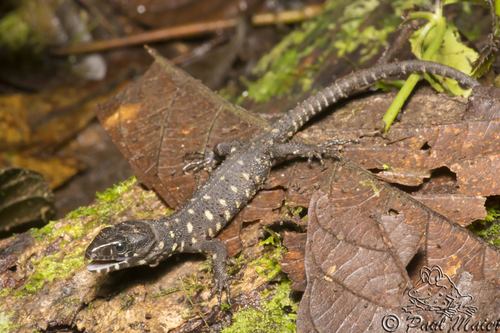
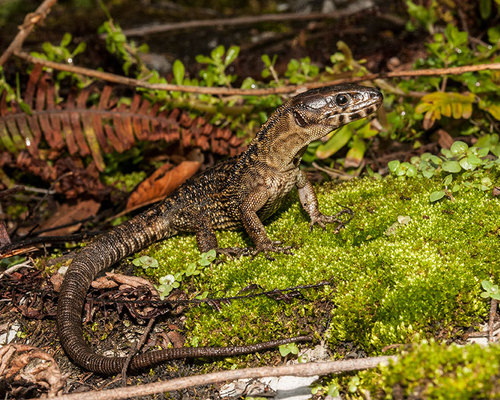
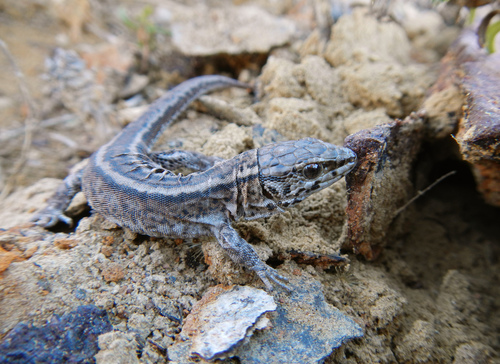
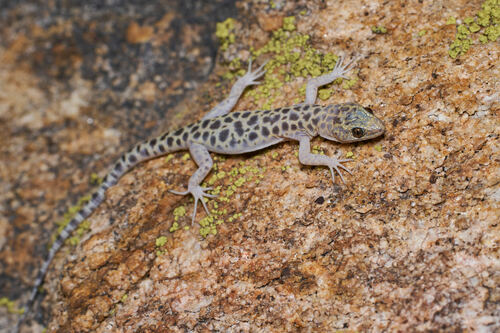
The desert night lizard, Xantusia vigilis Baird, 1859, reaches a snout-to-vent length of 1.5 to 2.75 inches (3.8 to 7.0 cm), with a tail roughly the same length as its body.
Base Color and Color Change
Its base coloring is usually grey, yellow-brownish, or olive, and it can easily change its own color from light olive, most common in the evening, to dark brown during the day.
Activity Pattern
Despite the "night lizard" common name, this species is active during the day, though it is also secretive, rarely leaving cover during the day and more active at night.
Climbing Ability and Diet
It is a good climber, and its diet consists mostly of termites, small insects, spiders and other arthropods.
Adult Size and Weight
It is a small reptile: average adult females measure 80 mm in total length and weigh 1.3 g, while adult males are slightly smaller, at 65 mm in total length and 1.1 g in weight.
Sexual Dimorphism
Males can be distinguished from females by their lighter color, shorter overall length, stouter and wider tail, and enlarged femoral pores.
Ventral and Dorsal Scales
Most individuals have 12 longitudinal rows of rectangular ventral scales, with 30 to 50 granular dorsal scales around the midsection.
Supraorbital Scales
Above each eye, they have specific supraorbital scales: one around the nasal bone, two on the frontal region, and two parietal scales.
Body Color Variation
Body color typically ranges from light gray to brown, most often as a single uniform shade, though some individuals have dark spots.
Core Geographic Range
This lizard is found along the Southwestern coast of the United States and in northern regions of Mexico, and is very common in the Mohave and Sonoran Deserts, across southern California and Baja California.
Outlying Populations
Smaller populations have also been recorded in western Arizona, central California coastal ranges, Colorado, the Sierra Nevada, and Utah.
Habitat Type
Like most species in the genus Xantusia, X. vigilis lives in arid and semi-arid habitats.
Daytime Sheltering and Plant Association
During the day it shelters in rock crevices or under fallen plant debris, and it is usually associated with Yucca species, including Yucca brevifolia (Joshua tree) and Yucca gloriosa.
Common Local Name
For this association, it is sometimes locally called the "Yucca Night Lizard".
Yucca Association and Population Density
While it can live in areas where Yucca does not grow, higher population densities are almost always found where yucca plants are present.
Litter Size
Xantusia vigilis typically produces no more than two offspring per birth.
Ovulation Laterality Preference
When only a single ovum is ovulated, there is a laterality preference for the specific oviduct and ovary used, with pressure for the right ovary to produce more mature ova.
Reproductive Activity Drivers
Reproductive activity in this species depends on several key factors, most notably climate variation, diet, and nutrition.
Climate Impact on Gestation
Climatic changes heavily shape the progression of gestation.
Damp Weather Ovulation Adjustment
In damp conditions, this lizard will move ovulation earlier or later to wait for drier weather; for example, in an unusually damp spring, ovulation is typically postponed until mid-summer of the same year.
Typical Breeding Season
Regardless of overall climate, breeding most often occurs during the spring and winter.
Diet Impact on Reproductive Success
Diet has a similar impact on reproductive success in a given season: improper diet and malnutrition often leads to underdeveloped ova and insufficient yolk deposition in females.
Dry Climate Reproductive Effects
Overly dry climates are generally linked to underdeveloped reproductive organs and reduced reproductive function.
Male Testicular Maturation Exception
A notable exception to this pattern is that males in drier climates and low-resource environments often reach a higher level of testicular maturation.
Ovulation Period and Temperature Range
The ovulation period for X. vigilis lasts approximately two weeks, and occurs at an optimal temperature range of 75–90 °F (24–32 °C).
Gestation Length
Gestation typically lasts 90 days.
Birth Timing and Delivery Duration
Birth has no preference for day or night, and the delivery process lasts around 10 minutes.
Species Lifespan
Desert night lizards have a lifespan of 8–10 years.
Annual Female Reproductive Rate
In any given year, only a percentage of adult female X. vigilis will reproduce.
Placenta Function
This species has a well-developed placenta that allows exchange of amino acids between mother and fetus.
Embryo Weight Gain
It is estimated that half of an embryo's total weight gain occurs during the short egg gestation period, via exchange from the oviduct wall through the placenta.
Newborn Size and Weight
At birth, newborns average 22–23 mm in snout-to-vent length and weigh approximately 0.23 g.
Post-Birth Maternal Behavior
X. vigilis mothers have been reported to eat their fetal membranes after birth.