About Xanthorrhoea preissii Endl.
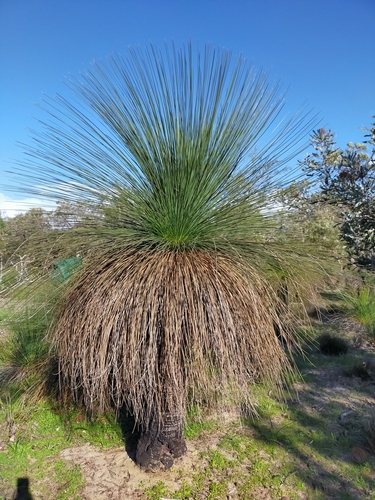
Xanthorrhoea preissii Endl. is a plant that grows with a tree-like form. It has very long, bunched, grass-like leaves that grow out from a central base. Its trunk can reach over 3 metres (9.8 ft) in height, and its often blackened appearance shows that this species is able to survive fire. Remains of its flammable leaves combined with annual new growth create visible banding on the trunk. This banding can be used to determine the plant's age, and also provides a record of past fires in its habitat. The inflorescence grows on an upright spike that measures 1.5 to 2.5 metres (4 ft 11 in to 8 ft 2 in) long, and appears between June and December. Its sessile flowers are creamy or white, and they grow much more abundantly after being stimulated by bushfire. This species is found across coastal plains, near watercourses, and in inland forest regions, across a range that extends from Geraldton to Albany, and also occurs in the Avon Wheatbelt. It grows on a wide variety of soil types, and is sometimes found associated with laterite and granite. Xanthorrhoea preissii is identified as one of the dominant species in the Corymbia calophylla – Xanthorrhoea preissii woodlands and shrublands of the Swan Coastal Plain, which is a critically endangered ecological community. This community was once widespread, but is now restricted to a very narrow range. The species is also a characteristic component of two other communities dominated by marri (Corymbia calophylla). The marri/Xanthorrhoea community is set apart by the drier soils that occur across its range along the eastern edge of the Swan Coastal Plain. This species held high economic importance for the Noongar people, who call it balga. The Noongar people use the gum produced by the plant, use its spike to make fish spears, and harvest the bardi grub from the plant as a source of food. Anecdotal information about the species notes that fire is connected to this plant in Noongar culture.