About Xanthorrhoea australis R.Br.
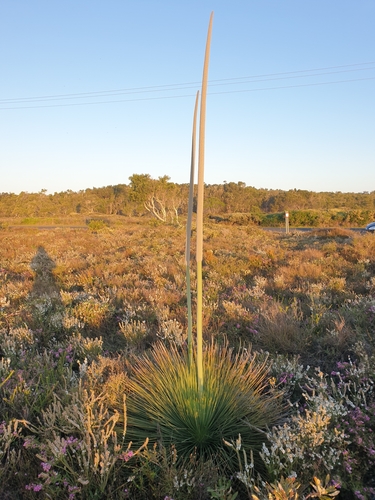
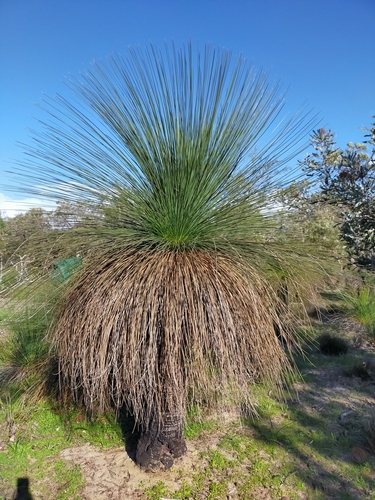
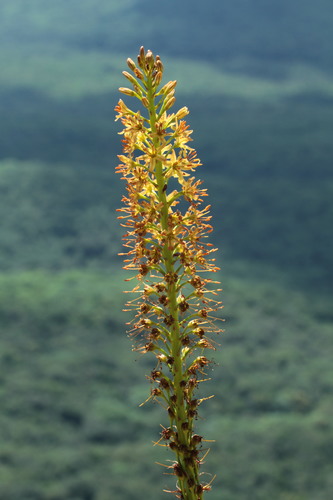
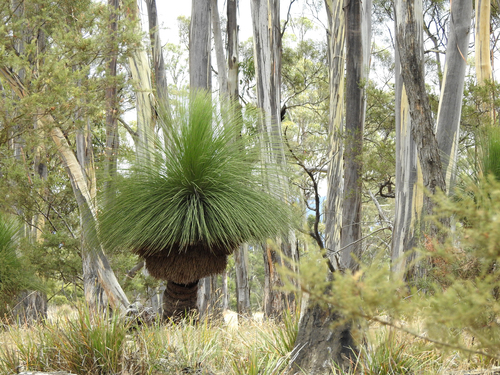
Xanthorrhoea australis R.Br. can be most reliably identified by the cross-section of its leaves: for this species, the cross-section is roughly diamond-shaped, and the leaves are bluish-green in color. This species typically grows a rough trunk that may be branched and is turned black from exposure to bushfires. Most trunks grow to over 3 metres (9.8 ft) in height and up to 1 metre (3.3 ft) wide, though three cultivated specimens at Benvie Arboretum in KwaZulu Natal, South Africa reach heights between 10.5 and 12 m (34–39 ft). The bark is thick, rough, and corky. The species grows very slowly, and trunks do not begin to develop until after many years of growth. Long, narrow leaves grow crowded together at the top of trunks. X. australis takes several years to produce flowers, does not flower reliably every year, but flowers heavily in the growing season after a bushfire. Flowers grow on a spear-like spike that can reach up to 2 metres (6.6 ft) tall. Each flower has 6 petals, and flowers cover between 1/2 and 5/6 of the spike stem. The overall crown of leaves is nearly spherical, with the tip of each leaf aligning to the shape of this implied sphere. Leaves grow in a crowded whorl of long, wiry leaves at the top of the trunk, arranged in a spiral. Young plants form an erect tuft, while the leaf crown spreads as the plant matures. The oldest leaves die and hang down to form a skirt around the trunk. The blue-green, needle-like leaves are typically 14 to 30 centimetres (5.5 to 11.8 in) long, have a waxy coating, and are softer and less rigid than leaves of other Xanthorrhoea species. The hanging skirt of old leaves is a distinctive feature that partially covers the fire-blackened trunk. X. australis flowers from July to December, though younger individual plants may flower as early as June. The common name "grass tree" is accurate because the trunks and branches of this tree-like plant are made entirely of packed leaf bases, not true wood. Grass trees are very long-lived, with some individuals estimated to be between 350 and 450 years old. This species is distributed across the Australian states of New South Wales, Australian Capital Territory, South Australia, Tasmania, and Victoria, and it is considered the most widely distributed species in the Xanthorrhoea genus. It grows on ancient, leached, nutrient-poor soils, and is particularly sensitive to phosphorus, a common trait among native Australian plants. It is also highly susceptible to Phytophthora cinnamomi, an invasive soil-borne pathogen that causes dieback disease (root rot). Indigenous Australians used this species in multiple ways: they soaked flowering spikes in water to make a sweet drink, ate the soft white leaf bases and the growing point of the stem. The flower spike produces resin that was used as an adhesive for tool manufacturing, and stems were used for the lower section of spears. Stems also served as the base for fire-drills used to start fires. Commercial processors collected the resin to make lacquer for furniture made by cabinet makers. In 1915, there was widespread public concern when it was discovered that German agents had bought immense quantities of grass tree gum over the previous 25 years, presumably to use in manufacturing explosives. Experiments at the time recorded that explosives made with grass tree resin were more powerful than dynamite.