About Xanthoria elegans (Link) Th.Fr.
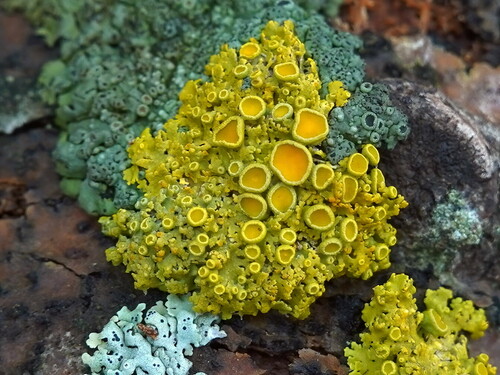
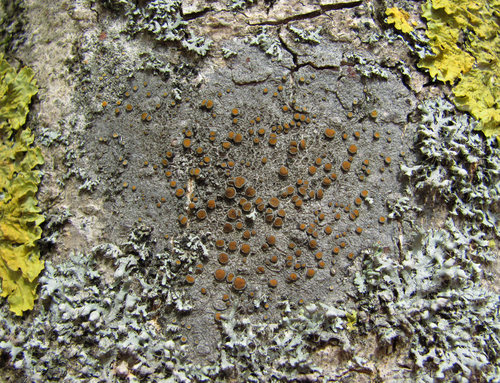
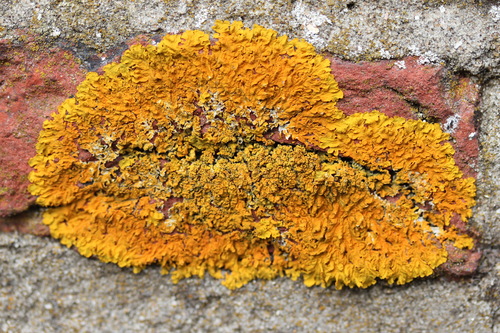
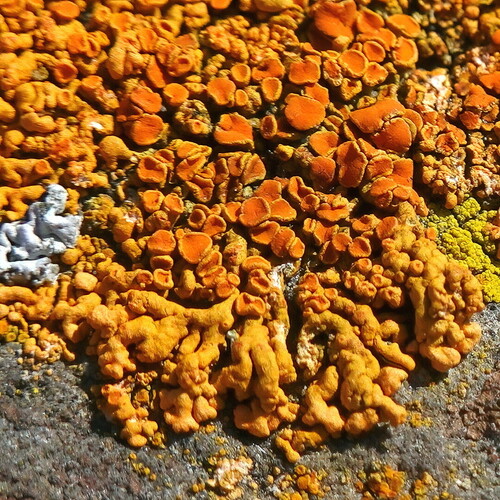
Xanthoria elegans (Link) Th.Fr. is a foliose lichen, meaning its body (thallus) has a leaf-like appearance, though the central portion of the thallus may look nearly crustose. It is small, usually under 5 cm (2 in) wide, with individual lobes less than 2 mm (0.08 in) broad, and lies appressed to loosely appressed against its substrate. Its upper surface is some shade of orange, while the lower surface is white and corticate, with short, sparse hapters—specialized attachment structures produced by some lichens. Vegetative propagules called soredia and isidia are not present on this species, but apothecia (reproductive structures) are common. Thallus form and color varies by growing location: it forms swollen, orange-yellow thalli in streams, compact orange thalli on boulders, and dark orange-red thalli on the driest rock faces. One variety, Xanthoria elegans var. granulifera (previously classified as R. elegans var. granulifera), produces isidium-like vegetative propagules, and has been recorded in Greenland and Spitsbergen. This species grows on both calcareous and siliceous rock, and occasionally grows over moss or litter. It is most often found in exposed to moderately sheltered sites, commonly in areas near bird or small mammal droppings. It has adapted successfully to grow on both natural and man-made surfaces, ranging from the sea spray zone to boreal forests and continental interior grasslands. It can grow well in areas with less than 6 centimetres (2.4 in) of annual precipitation, and can survive submerged in streams for most of the growing season. It has a broad circumpolar and alpine distribution, occurring on all continents except Australia, and is widespread across Antarctic regions. This lichen is used as a model system to study the ability of organisms to resist the extreme conditions of outer space. Among multiple lichen species tested, Xanthoria elegans can recover from space-simulating conditions, including 16 hours of exposure to vacuum at 10−3 Pa, and UV radiation with wavelengths less than 160 nm or greater than 400 nm. It also survived 18 months of exposure to solar UV radiation, cosmic rays, vacuum, and fluctuating temperatures in an experiment conducted by the European Space Agency outside the International Space Station.