About Xanthorhoe spadicearia (Denis & Schiffermüller), 1775
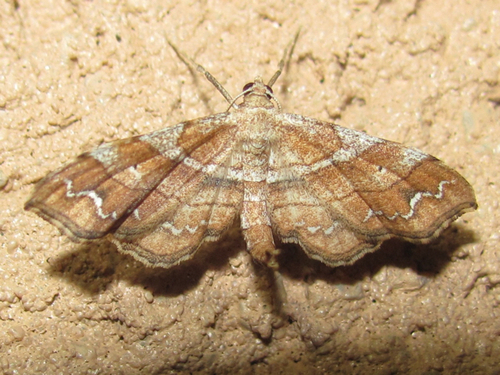
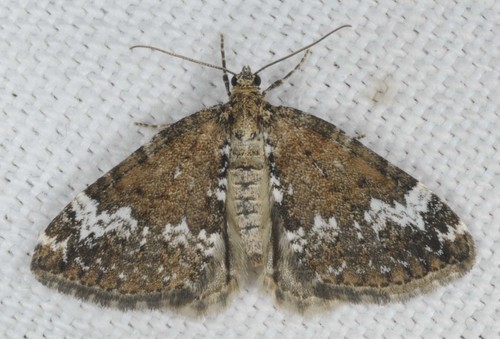
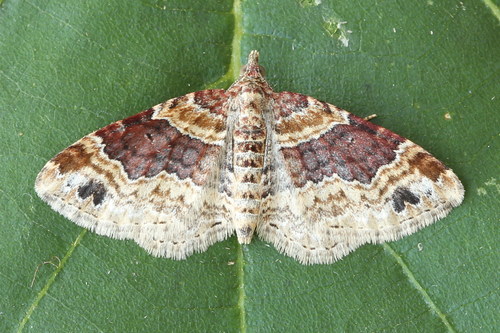
This species, Xanthorhoe spadicearia (Denis & Schiffermüller), 1775, has forewings that are strongly marked with lines, and are much mixed with ferruginous ochreous in the distal area, or at least around the paired dark spots. The median band has a distinct shape, and is often a brighter or lighter red, less purplish, and is never black. The hindwing is darker on the distal portion than on the proximal portion, and the underside is strongly mixed with ochreous. The species is highly variable. Several named aberrations are recognized: ab. confixaria H.-Sch. has a narrowed median band and a somewhat weakly marked, rather uniformly ochreous distal area. According to Staudinger, livinaria Lah. is likely a very extreme aberration, with a threadlike median band and a broadly darkened distal area. ab. georgi Meissl is an unusual dark brown aberration, where the median band is only indicated by narrow dark proximal and distal bars, with the distal bar only distinct along the costa. ab. deletata Fuchs is nearly uniformly grey, with the forewing having a reddish tinge at the base and along the costal margin. tromsoensis Fuchs is a common form found at high elevations and high latitudes, but is barely a fixed geographical race; in this form the median band is paler, sometimes almost completely gone, while the lines that cross it remain distinct. Typical Xanthorhoe spadicearia, which includes all the aberrations described above, lives across most of Europe, excluding some southern localities, and is also found in Siberia, specifically the Tunka and Sajan regions. The subspecies or race asiatica Stgr., found from the Tarbagatai district to Issyk-kul, is a very distinct race that may be a separate species. Its ground colour is somewhat yellowish, with plentiful darker yellow markings especially in the distal area. The basal and median areas of the forewing are a very dull reddish to blackish, and the median area has much straighter edges than in other forms. The proximal half of the hindwing is rather strongly darkened. Xanthorhoe spadicearia is difficult to identify with certainty when compared to Xanthorhoe ferrugata (Denis & Schiffermüller, 1775); see Townsend et al. for further information. Mature caterpillars are smooth and slender. They are ochre, brownish, or greenish in colour, with a dark brown dorsal line and light, black-brown diamond-shaped spots on the middle segments. Xanthorhoe spadicearia has a Palearctic distribution, ranging from Ireland through northern Europe eastward to southern Siberia. It colonizes a wide variety of different biotopes, and occurs in both dry and humid habitats, as well as urban habitats. In the Alps, it can be found at elevations up to 2100 metres.