About Xanthogaleruca luteola (O.F.Müller, 1766)
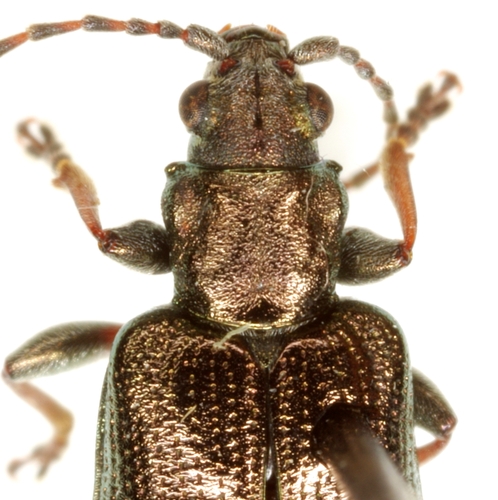
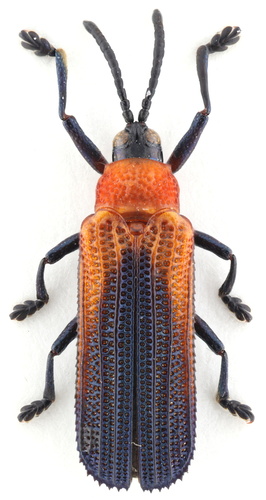
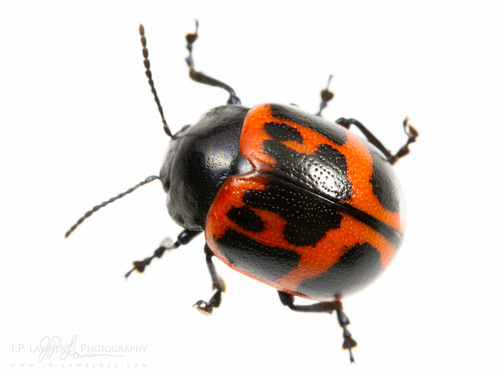
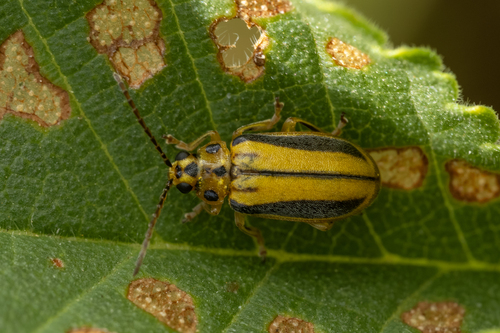
The adult imago of Xanthogaleruca luteola is 6–8 mm long, and ranges in color from yellow to green. It has a spot on its head, an hourglass mark plus two spots on the pronotum, and a broad dark stripe along the edge of each elytron. Larvae are usually black, occasionally black and yellow, grow to less than 13 mm long, and have multiple rows of dots on their back and sides. Pupae are orange-yellow with black chaetae. Eggs are yellow, and laid in spindle-shaped clusters of fewer than 25 on the undersides of elm leaves.
This beetle species is common across the Western Palearctic realm, ranging from Portugal to Central Asia. It is indigenous to Europe, but was accidentally introduced to North America and Australia, where it is now widespread. It is a serious pest in Australia and parts of North America.
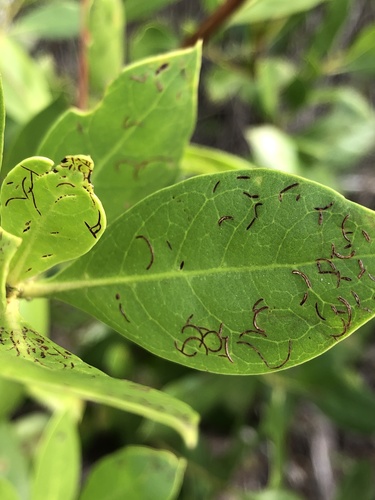
Xanthogaleruca luteola is a serious pest of elm trees. Both adults and larvae feed on newly emerged elm leaves. Repeated heavy infestation rarely kills an elm tree outright, but it weakens the tree and leaves it vulnerable to disease. Weakened trees produce falling branches that encourage elm bark beetles (Scolytus multistriatus and S. schevyrewi) to multiply; these bark beetles are vectors of Dutch elm disease.
Elm leaf beetles become active in spring once temperatures rise above 11 °C (52 °F). Weather is one of the most limiting factors for their population growth: a late spring freeze or long winter can kill entire colonies. Adults leave their hibernation sites, which are often human residences, and females lay their eggs on the underside of elm leaves. Eggs hatch after one week, and larvae immediately begin feeding on the underside of leaves. The larval stage lasts between two and three weeks. After this stage, larvae migrate to the lower part of trees to find bark crevices where they can pupate. The next generation emerges in midsummer after two to three weeks of pupation, and begins feeding on elm leaves.
A female X. luteola can lay around 800 eggs, but oviposition is interrupted when the photoperiod shortens to less than 14 hours. This shortening induces a short period of feeding before the beetle searches for a hibernation site. Known host plants for this species include English elm (Ulmus minor 'Atinia'), wych (Scots) elm (Ulmus glabra), American elm (Ulmus americana), Siberian elm (Ulmus pumila), Chinese elm (Ulmus parvifolia), and complex elm hybrids such as 'Homestead'. The beetle has also been reported feeding and living on Zelkova serrata.
When X. luteola lays eggs on Ulmus minor, the plant releases specific volatiles that attract the egg parasitoid Oomyzus gallerucae. Ulmus minor can distinguish between oviduct secretions, which are small molecule proteinaceous compounds, and physical damage that occurs naturally during oviposition, and releases different volatiles when it detects oviduct compounds. Oomyzus gallerucae can distinguish between these different sets of volatiles, and is only attracted to volatiles released in response to oviposition. Gravid X. luteola females respond inversely to these volatiles: they are attracted to volatiles that indicate undamaged and/or unoviposited Ulmus plant material. Gene expression studies have shown that a large number of genes are involved in the oviposition response process, part of tritrophic interactions in plant defense. Jasmonic acid is released when gravid X. luteola females feed on Ulmus species.